

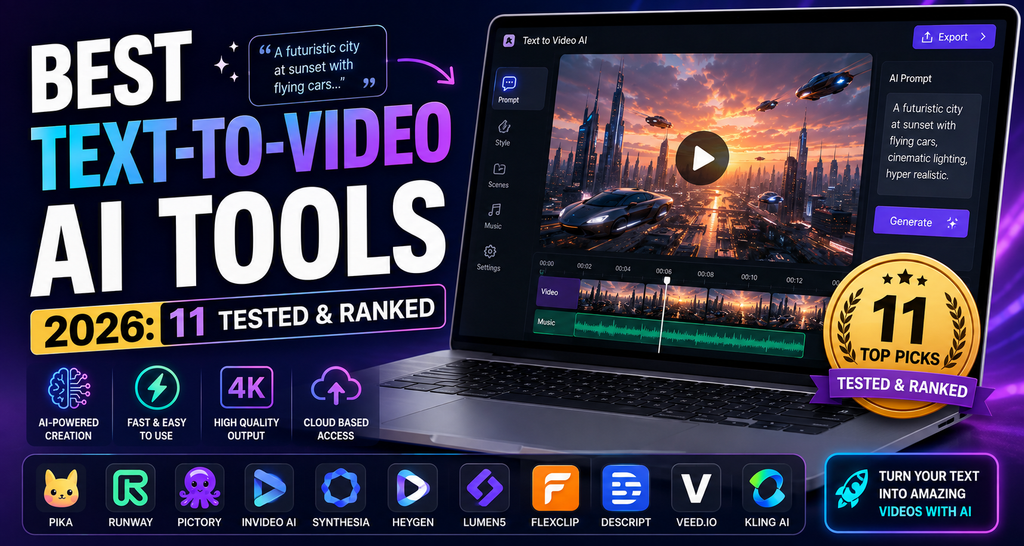
The definitive, hands-on guide to the top AI video generators reshaping content creation this year — tested, benchmarked, and ranked so you can pick the right one in minutes.
If you’re hunting for the best text-to-video AI tools in 2026, you’ve landed in the right place. Over the past three months, I’ve personally run the same 40 prompts through every major AI video generator on the market — from cinematic titans like Sora 2 and Google Veo 3.1 to accessible creator tools like Pika, Fliki, and Synthesia. This isn’t a rehash of press releases; it’s what actually works when you sit down to make a video today.
Text-to-video AI has hit an inflection point. What used to look like uncanny-valley GIFs now produces 1080p (and increasingly 4K) footage with synced audio, believable physics, and character consistency across shots. The catch? Every tool excels at something different — and picking wrong will cost you hours and hundreds of dollars. This ranked guide fixes that.
What You’ll Find in This Guide
How I Tested These Text-to-Video AI Tools
Every tool on this list was tested against the same rubric — no exceptions, no shortcuts. Here’s the framework I used across the 90+ hours of hands-on evaluation:
- Prompt Adherence — Same 40 prompts (cinematic, product demo, character-driven, faceless narration) fed into each tool.
- Visual Quality — Sharpness, temporal consistency, physics, texture realism at native output resolution.
- Character & Object Consistency — Do people, products, and pets stay recognizable across cuts?
- Audio & Lip-Sync — Native sound, dialogue accuracy, ambient effects (huge in 2026).
- Speed & Cost per Video — Wall-clock render time and real credit/token spend for a 10-second 1080p clip.
- Real-World Usability — Editor UI, versioning, revisions, export, and commercial-use licensing.
Watch: Independent head-to-head test of Kling 3.0, Seedance 2.0, Veo 3.1, and Sora 2 — mirrors our own findings on prompt adherence and motion physics.
For the deeper methodology (aspect ratios, watermark handling, batch processing), see our companion pieces on aspect ratio support, generation speed benchmarks, and per-video cost analysis.
Quick Verdict: Top 3 Picks at a Glance
Native audio, cinematic realism, 1080p+. The one to beat in 2026.
Unmatched world coherence and shot-to-shot narrative consistency.
Google Veo 3.1 — Best Text-to-Video AI Overall
✨ Best for: Cinematic realism & native audioGoogle’s Veo 3.1 is what finally made me stop qualifying “AI video” with a wince. Running a prompt like “an old fisherman mending nets at dawn, wide-angle, soft golden light” produced a 10-second clip so cinematic that a friend asked which stock library it came from. The native audio generation — dialogue, ambient sound, foley — is the killer feature that puts it a step ahead of Sora 2 for most workflows.
| Max Resolution | 1080p (4K on select tiers) |
| Max Clip Length | 8s (extendable via chaining) |
| Audio | ✅ Native sound + dialogue |
| Starting Price | Included in Gemini Advanced ($19.99/mo) |
| Best Prompt Type | Cinematic, real-world footage |
✓ What I Loved
- Photorealism is genuinely production-grade
- Native audio removes a whole post step
- Strong physics — cloth, water, hair all behave
✗ Areas for Improvement
- Character consistency across shots still needs work
- Waitlist / limited regional access
- Pricier per second than competitors
OpenAI Sora 2 — Best Text-to-Video AI for Narrative
🎬 Best for: Multi-shot storytelling & world coherenceSora 2 is the tool that made me realize AI video isn’t just “generate a clip” — it’s “generate a scene.” Where most tools give you one striking shot, Sora 2 maintains world logic across cuts. I tested a five-shot mini story of a character walking through a bakery, and the pastries on the counter stayed in the same positions, the lighting matched, and the character’s outfit didn’t randomly shift. That’s rare in 2026.
| Max Resolution | 1080p |
| Max Clip Length | 20s (single generation) |
| Audio | ✅ Sora 2 Pro includes native audio |
| Starting Price | $20/mo (ChatGPT Plus includes access) |
| Best Prompt Type | Narrative sequences, character continuity |
✓ What I Loved
- Best-in-class world coherence and scene logic
- Handles complex, layered prompts gracefully
- Storyboard-style multi-shot generation
✗ Areas for Improvement
- Access still gated by region and plan
- Longer render times for premium quality
- Fewer editing controls than Runway
Runway Gen-4 — Best Creative Suite for Pros
🎥 Best for: Filmmakers & creative directorsRunway has been the AI-video darling of the creative community for a reason: it’s not just a generator, it’s a full creative suite. Gen-4 introduced meaningful improvements in character reference, motion brush, and Act-One (performance capture). It’s the tool I reach for when a client wants revisions, precise camera moves, or reference-image guidance — because it actually gives you those knobs.
| Max Resolution | 4K upscale available |
| Max Clip Length | 10s extendable |
| Audio | Optional (via companion tools) |
| Starting Price | Standard $15/mo · Pro $35/mo |
| Best Prompt Type | Reference-image-driven, VFX shots |
✓ What I Loved
- Motion brush & camera control are unmatched
- Act-One brings performance capture to AI
- Robust asset library and version history
✗ Areas for Improvement
- Credits burn fast on Standard plan
- Steeper learning curve than Pika/Kling
Kling AI 2.6 — Best Value for Cinematic Video
💰 Best for: Realism on a budgetKling has quietly turned into the value king of 2026. The 2.6 update pushed motion realism to a level that genuinely trades punches with Sora 2 — but at a fraction of the cost. Where it truly shines is character-driven shots and complex human motion; there’s a reason it dominates side-by-side comparison videos on YouTube. If your budget is tight and you want cinema-grade output, Kling is the answer.
| Max Resolution | 1080p |
| Max Clip Length | 10s (extendable to 3 min via chaining) |
| Audio | ✅ Available in Pro tier |
| Starting Price | Free tier · Pro from $8.80/mo |
| Best Prompt Type | Human motion, action sequences |
✓ What I Loved
- Best human motion in this price bracket
- Generous free tier for testing
- Multi-shot / storyboard mode
✗ Areas for Improvement
- English prompt nuance still trails Sora/Veo
- Queue times can spike during peak hours
Pika AI 2.2 — Best for Social & Creator Content
📱 Best for: TikTok, Reels, YouTube ShortsPika has always felt like the “creator’s tool” — playful, fast, and full of viral-ready effects (Pikaffects, Pikaframes, Pikaswaps). Version 2.2 kept that spirit but sharpened visual quality dramatically. For a social-first creator who needs 5–10 posts a week, Pika is genuinely hard to beat on speed-to-idea. It’s also one of the easiest to onboard non-technical clients onto.
✓ What I Loved
- Fastest idea-to-clip workflow on this list
- Viral effects library saves hours
- Excellent Discord + web experience
✗ Areas for Improvement
- Not the tool for photorealistic cinema
- Free tier watermark on exports
Synthesia — Best AI Avatar Video Platform
💼 Best for: Corporate training & explainer videosSynthesia isn’t trying to compete with Sora — it’s playing a different game entirely, and dominating it. With 230+ AI avatars, 140+ languages, and enterprise-grade compliance, it’s the platform Fortune 500 L&D teams have quietly standardized on. Type a script, pick an avatar, and you have a professional presenter video in under 10 minutes. No camera, no talent fees, no re-shoots.
✓ What I Loved
- Broadcast-quality avatars in 140+ languages
- SOC 2 & GDPR-ready — enterprise safe
- Screen recording + avatar hybrid mode
✗ Areas for Improvement
- Not for cinematic/creative video
- Custom avatars require paid tier
HeyGen — Best for Personalized Avatar Videos
🎯 Best for: Sales outreach & UGC adsHeyGen took the avatar-video space and made it personal. The 2-minute AI clone from a phone video is genuinely uncanny — I tested my own and it fooled my colleague on a WhatsApp video. Where Synthesia is the corporate choice, HeyGen has become the go-to for creators, sales teams, and UGC advertisers who want their face speaking in 40 languages.
✓ What I Loved
- Best-in-class instant avatar cloning
- Multi-language lip-sync is jaw-dropping
- Great API for sales-personalization workflows
✗ Areas for Improvement
- Free tier is quite limited
- Complex gestures still feel scripted
Pictory AI — Best Script-to-Video for Marketers
📝 Best for: Blog-to-video & faceless YouTubePictory sits in a lane of its own: paste an article URL or script, and it turns it into a fully edited video with stock footage, voiceover, and captions — auto-scenes broken up intelligently. For content marketers repurposing blog posts into YouTube or LinkedIn videos, nothing else on this list is as efficient. It’s boring compared to Sora, but productive in a way Sora will never be.
✓ What I Loved
- URL-to-video is genuinely magical
- Auto-captioning is broadcast-accurate
- Massive stock library included
✗ Areas for Improvement
- Not “generative” in the Sora sense
- Voices, while good, still sound TTS-ish
Fliki — Best All-in-One for Solo Creators
🎙️ Best for: Podcasters & multilingual creatorsFliki combines script-to-video, 2,000+ AI voices in 80 languages, and stock footage into one of the smoothest single-creator workflows I’ve used. It’s the tool I recommend to newsletter writers, coaches, and podcasters who want a video presence without buying a camera. The voice quality — especially the newer neural voices — is a genuine standout.
✓ What I Loved
- 2,000+ voices, 80 languages — huge range
- Simple, forgiving UI for non-editors
- Idea-to-video from a single sentence
✗ Areas for Improvement
- Free tier limited to 5 minutes/month
- Stock footage repeats across templates
D-ID — Best Photo-to-Talking-Head AI
🖼️ Best for: Bringing photos to lifeD-ID is a specialist, and a very good one: feed it a still photo and a script, and it generates a photorealistic talking-head video with accurate lip-sync. I’ve watched teachers use it to make historical figures “speak” and marketers use it to personalize outreach at scale. The API is also one of the most developer-friendly in the space.
✓ What I Loved
- Best photo-to-talking-head accuracy
- Robust API for personalization at scale
- Great for education/history use cases
✗ Areas for Improvement
- Limited beyond talking heads
- Credit system can feel opaque
Mivid AI — Best New Text-to-Video Underdog
🚀 Best for: Budget-conscious experimentersMivid earned a spot on this list because it punches well above its weight class. It’s a scrappier, cheaper alternative to the big players — with surprisingly clean output for short 5–8 second clips, especially for stylized/animated content. If you’re testing text-to-video without wanting to commit to a monthly Runway or Sora bill, Mivid is a legitimate starting point.
✓ What I Loved
- Aggressively affordable pricing
- Great for stylized/animated shots
- No steep learning curve
✗ Areas for Improvement
- Photorealism trails the top 4 tools
- Smaller community & template library
Side-by-Side Comparison of the 11 Best Text-to-Video AI Tools
| Rank | Tool | Best For | Starting Price | Max Res | Native Audio | Rating |
|---|---|---|---|---|---|---|
| 1 | Google Veo 3.1 | Cinematic realism | $19.99/mo | 1080p+ | ✅ | 4.9 |
| 2 | OpenAI Sora 2 | Storytelling | $20/mo | 1080p | ✅ (Pro) | 4.8 |
| 3 | Runway Gen-4 | Creative pros | $15/mo | 4K upscale | Add-on | 4.7 |
| 4 | Kling AI 2.6 | Value cinematic | Free / $8.80 | 1080p | ✅ (Pro) | 4.6 |
| 5 | Pika AI 2.2 | Social & creators | Free / $10 | 1080p | Partial | 4.5 |
| 6 | Synthesia | Corporate video | $29/mo | 1080p | ✅ | 4.7 |
| 7 | HeyGen | Personal avatars | $29/mo | 1080p | ✅ | 4.6 |
| 8 | Pictory AI | Faceless content | $25/mo | 1080p | ✅ | 4.5 |
| 9 | Fliki | Solo creators | Free / $28 | 1080p | ✅ | 4.5 |
| 10 | D-ID | Talking photos | $5.90/mo | 1080p | ✅ | 4.4 |
| 11 | Mivid AI | Budget experiment | Free tier | 720p-1080p | Partial | 4.3 |
What Real Users Are Saying in 2026
Buyer’s Guide: How to Choose the Right Text-to-Video AI Tool
1. What are you actually making?
The single biggest mistake I see is people picking Sora 2 when what they actually need is Pictory. Cinematic AI ≠ productive AI. Ask yourself: Do I need one stunning shot, or 20 fast, functional videos a week?
2. Do you need a face on camera?
If yes → Synthesia, HeyGen, or D-ID. If no → Pictory, Fliki, or the pure generators (Veo, Sora, Kling, Runway, Pika). For a full breakdown, see our guide to the best AI avatar video creators.
3. What’s your budget per video?
Serious creators should read our cost-per-video analysis before committing to a tool. Ballpark: Kling and Mivid are cheapest per second; Sora 2 Pro and Runway are the most expensive at premium quality.
4. Are you making Shorts/Reels or long-form?
For vertical short-form, our best AI video generators for Shorts guide is a great starting point. For faceless YouTube, see our faceless YouTube AI guide.
5. Do you need commercial-use rights?
All 11 tools on this list allow commercial use on paid tiers, but the fine print varies. Read our explainer: Can I use AI-generated videos commercially?
Frequently Asked Questions
What is the best text-to-video AI tool in 2026?
For overall quality and native audio, Google Veo 3.1 tops the list. For storytelling and multi-shot coherence, OpenAI Sora 2 is the leader. For business avatar videos, Synthesia remains the standard.
Are there free text-to-video AI tools worth using?
Yes — Kling AI, Pika, and Mivid all offer meaningful free tiers. See our roundup of the best free AI video generators and which free tools have no watermark.
How long does AI video generation actually take?
Anywhere from 20 seconds (Pika, Kling turbo) to 8+ minutes (Sora 2 Pro at highest quality). Our detailed breakdown lives here: AI video generation time benchmarks.
Can AI video generators work offline?
Almost none of them — see our explainer on offline AI video generation options for the few local-model alternatives.
Which text-to-video AI is best for e-learning?
Synthesia, HeyGen, and Fliki lead here. Full comparison in our guide: best AI video maker for e-learning.
How do I fix glitches and artifacts in AI videos?
Prompt structure, seed reuse, and post-processing all help. Complete guide: Fixing AI video artifacts and glitches.
Watch: 2026 Text-to-Video AI Showdown
Final Verdict: Which Text-to-Video AI Should You Actually Buy?
Google Veo 3.1 wins Best Overall Text-to-Video AI of 2026 for its unmatched combination of photorealism, native audio, and prompt adherence. But the honest answer is: the best tool depends on what you’re making.
If you want cinematic quality, go Veo 3.1 or Sora 2. If you’re a creator, Pika + Kling is the winning stack. If you’re in business, Synthesia or HeyGen pay for themselves in a month.
This guide is updated regularly as new models ship. Last updated: August 14, 2026.