

Quick Answer: Yes, you can often use AI generated videos commercially, but it depends entirely on the platform’s terms of service, the content used to generate the video, and whether the output contains third-party copyrighted material. There is no universal rule. You must check each tool’s license before monetizing any AI-generated content.
Key Takeaways
- Platform terms of service are the first thing to check. Most paid AI video tools grant commercial rights; many free tiers do not.
- Copyright law around AI-generated content is still evolving in 2026. The U.S. Copyright Office has confirmed that purely AI-generated works (with no human creative input) cannot be registered for copyright protection.
- Training data risk is real. If an AI was trained on copyrighted footage, music, or likenesses, your output could carry legal exposure.
- Music and voice are the biggest landmines. AI-generated music and cloned voices often have separate licensing terms from the video itself.
- Commercial use ≠ royalty-free forever. Some platforms grant commercial rights only on paid plans or with attribution requirements.
- Watermarks on free-tier outputs often signal restricted commercial use.
- Indemnification clauses in some platforms protect you from third-party copyright claims; others explicitly disclaim any protection.
- Always document your workflow. Keep records of the prompts, platform, plan tier, and date of creation for any commercially used content.
What Does “Commercial Use” Actually Mean for AI Video?
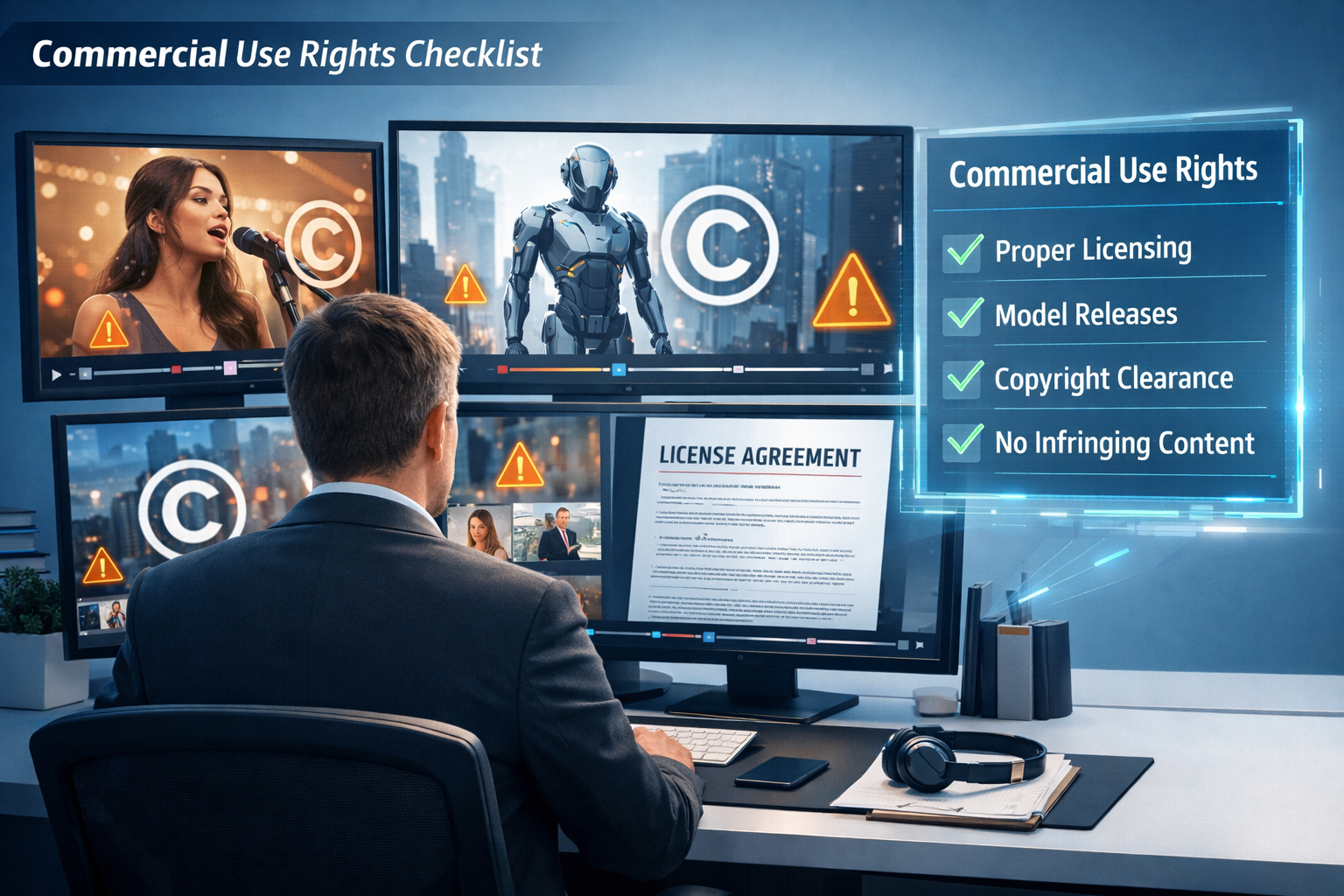
Commercial use means you’re using content to generate revenue, directly or indirectly. This includes ads, product videos, paid courses, client deliverables, YouTube monetization, and social media promotions for a business.
For AI generated videos, commercial use rights are granted by the platform, not by copyright law automatically. The key distinction:
- Personal/educational use: Generally permitted on most platforms, even free tiers.
- Commercial use: Requires explicit permission, usually through a paid subscription or a specific commercial license.
Common mistake: Assuming that because you created the video using an AI tool, you own all rights to it. Ownership and usage rights are two separate things.
Can I Use AI Generated Videos Commercially Without Copyright Issues on Free Plans?
Usually, no. Free plans from most AI video platforms either restrict commercial use outright or require attribution that may not be acceptable for professional work.
Here’s a general breakdown of what to expect:
| Plan Type | Commercial Use Allowed? | Attribution Required? | Watermark? |
|---|---|---|---|
| Free tier | Rarely | Often | Usually |
| Starter/Pro paid | Usually yes | Sometimes | No |
| Business/Enterprise | Yes | No | No |
| Custom license | Defined in contract | Defined in contract | No |
Decision rule: If you’re generating videos for a client or monetized channel, always use a paid plan and confirm commercial rights in the platform’s terms before you deliver anything.
Tools like Pika AI and Keyvello offer commercial rights on their paid tiers, but the specifics vary. Always read the fine print.
What Are the Biggest Copyright Risks in AI Video Generation?
The question “can I use AI generated videos commercially without copyright issues?” really comes down to three risk areas:
1. Training data liability
Some AI models were trained on copyrighted video, images, or music without explicit licensing. If a generated output closely resembles a copyrighted work, you could face a claim. This risk is higher with lesser-known or open-source models.
2. Music and audio
Background music in AI-generated videos is a frequent problem. Many tools pull from libraries that are only licensed for personal use. If you’re using a tool like LatentSync for lip-sync or EchoMimicV2 for portrait animation, check whether the audio layer has separate commercial licensing.
3. Likeness and personality rights
AI tools that generate realistic human faces or clone voices can trigger right-of-publicity laws, especially if the output resembles a real person. This is separate from copyright and varies by jurisdiction.
How Do Platform Terms of Service Affect Commercial Rights?
Platform terms of service (ToS) are the legal foundation of your commercial rights. They override any assumptions you might make about AI-generated content.
Key things to look for in any AI video platform’s ToS:
- Grant of license: Does it explicitly say “commercial use permitted”?
- Ownership clause: Does the platform claim co-ownership of outputs?
- Indemnification: Does the platform protect you from third-party copyright claims, or do they disclaim all liability?
- Prohibited content: Are there restrictions on using outputs in certain industries (e.g., adult content, political ads)?
- Plan-specific restrictions: Are commercial rights only available on higher-tier plans?
For example, Trupeer is designed for product and screen recording videos, which typically have cleaner commercial rights because the source material is your own. Tools that generate entirely synthetic content from text prompts carry more ambiguity.
Pull quote: “The platform’s terms of service are your actual license agreement. If it doesn’t say ‘commercial use permitted,’ assume it isn’t.”
What Does U.S. Copyright Law Say About AI-Generated Videos in 2026?
The U.S. Copyright Office has taken a clear position: works generated entirely by AI, without sufficient human creative authorship, are not eligible for copyright protection. This was reinforced in guidance issued in 2023 and has shaped how courts and practitioners approach the issue in 2026.
What this means practically:
- You may not own copyright in a purely AI-generated video, even if you paid for the tool.
- You can still use it commercially if the platform’s ToS grants you a license to do so.
- Adding human creative elements (editing, original narration, custom graphics) can establish partial copyright in those elements.
- Other countries have different rules. The EU, UK, and other jurisdictions are still developing their frameworks. If you’re selling internationally, this matters.
The lack of copyright protection in AI outputs also means competitors can potentially copy your AI-generated videos without infringing on your rights, unless you’ve added original human-authored elements.
Can I Use AI Generated Videos Commercially Without Copyright Issues When Using Third-Party Assets?
No, not automatically. If your AI-generated video incorporates third-party assets (stock footage, music, logos, or real people’s faces), those elements carry their own copyright status regardless of the AI tool used.
Steps to stay protected:
- Use only assets from the platform’s licensed library, confirmed for commercial use.
- If adding music, use a platform with a commercial music license (not just “royalty-free”).
- Avoid generating realistic likenesses of identifiable real people.
- For client work, get a written confirmation from your platform that commercial use is permitted under your current plan.
- Keep records of every asset source and license.
Tools like FacelessReels and Vid AI are built specifically for faceless content, which sidesteps many likeness-related risks.
What Should I Do Before Using AI Video Commercially?
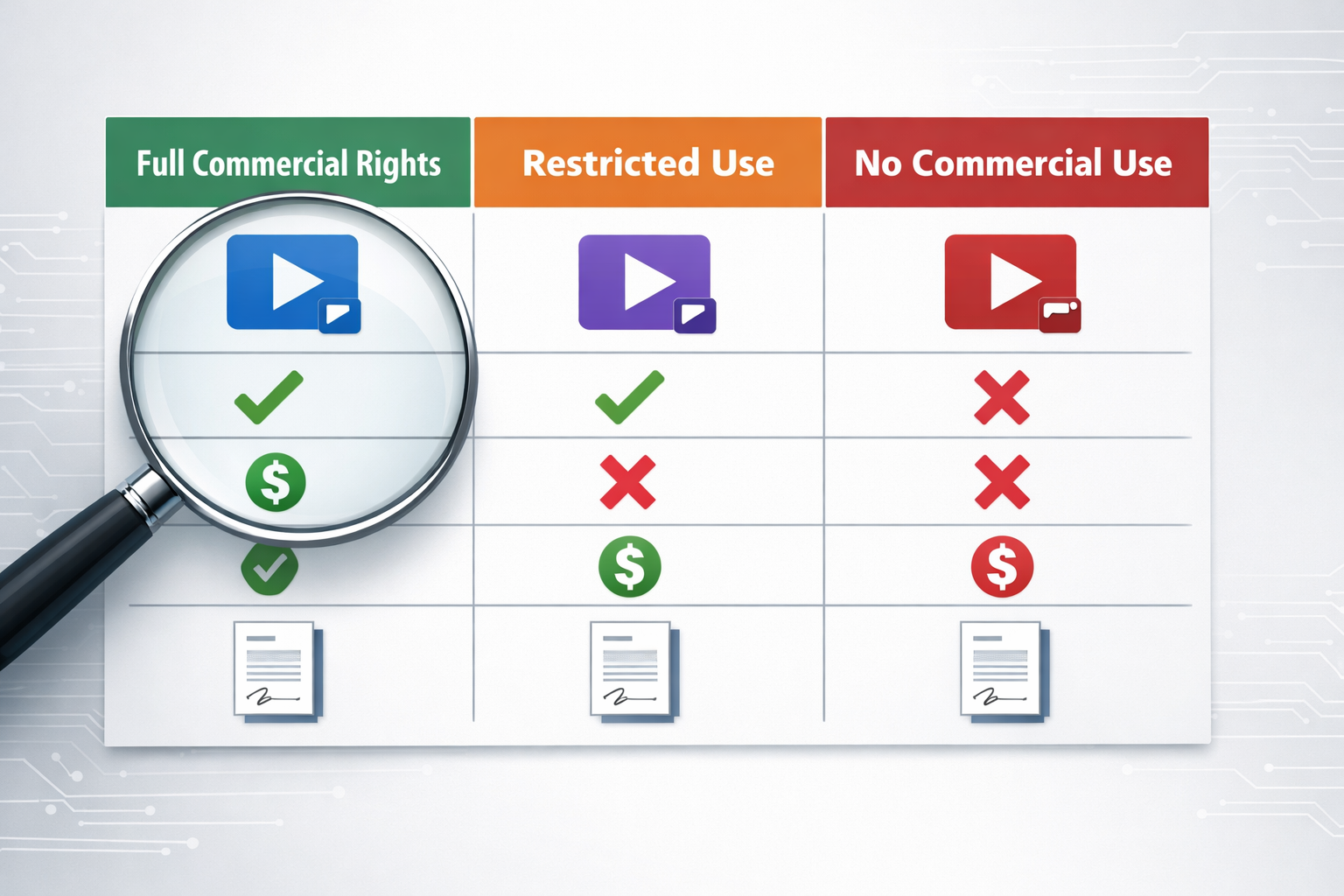
A practical pre-launch checklist for any AI-generated video you plan to monetize:
- Confirm your platform plan explicitly grants commercial rights
- Check whether the output contains AI-generated music, voices, or faces with separate licensing
- Review the platform’s indemnification clause
- Add original human-authored elements to strengthen your position
- Save the platform’s ToS version you agreed to (they can change)
- Document your prompt, creation date, and platform
- If using for client work, include a clause in your contract about AI-generated content
For more tool-specific guidance, the ReviewNexa AI Video & Media Tools category covers licensing details across dozens of platforms.
FAQ
Q: Do I automatically own copyright in AI-generated videos I create?
Not in the U.S. The Copyright Office has stated that purely AI-generated works lack the human authorship required for copyright protection. You may own rights to original elements you add.
Q: Can I sell AI-generated videos to clients?
Yes, if your platform’s ToS permits commercial use on your plan. Always confirm this before delivering client work and keep documentation.
Q: Is there a difference between “royalty-free” and “commercial use permitted”?
Yes. Royalty-free means no ongoing fees per use. Commercial use permitted means you can use it to generate revenue. You need both for most business applications.
Q: What happens if the AI tool I used goes out of business?
Your license may become void or unenforceable. This is a real risk with newer platforms. For high-stakes commercial projects, use established platforms with clear contractual terms.
Q: Can competitors copy my AI-generated videos legally?
Potentially yes, if the video lacks sufficient human authorship for copyright protection. Adding original creative elements is the best defense.
Q: Are AI-generated voices safe to use commercially?
Only if the platform explicitly licenses the voice for commercial use. Many AI voice tools restrict commercial use or have separate voice licensing terms.
Q: Does using a paid plan always mean I have commercial rights?
Not always. Some platforms have paid plans that still restrict commercial use. Read the ToS for your specific plan tier.
Q: What’s the safest AI video tool for commercial use?
Tools with explicit commercial licenses, indemnification clauses, and enterprise plans (like those reviewed at ReviewNexa) are generally safer. No tool is 100% risk-free.
Q: Can I use AI-generated videos in YouTube ads?
Yes, if your platform grants commercial rights. YouTube’s own policies also apply, particularly around synthetic media disclosure.
Q: Do I need to disclose that a video is AI-generated?
In some contexts, yes. Platforms like YouTube require disclosure for realistic synthetic media. Some jurisdictions are introducing mandatory disclosure laws in 2026.
Conclusion: Actionable Next Steps
The short answer to “can I use AI generated videos commercially without copyright issues?” is: yes, but only with the right platform, the right plan, and the right content.
Here’s what to do right now:
- Audit your current tools. Pull up the ToS for every AI video platform you use and confirm whether your plan includes commercial rights.
- Upgrade if needed. If you’re on a free tier and using outputs commercially, you’re likely violating your license agreement.
- Add human creative input. Edit, narrate, or customize AI outputs to strengthen your ownership claim over the final product.
- Document everything. Treat each AI-generated commercial video like a business asset with a paper trail.
- Stay current. Copyright law around AI is changing fast. Check for updates from the U.S. Copyright Office and your country’s equivalent body at least quarterly in 2026.
The legal landscape is still catching up to the technology. Being proactive now protects you from costly disputes later.
References
- U.S. Copyright Office. Copyright and Artificial Intelligence, Part 1: Digital Replicas. 2023. https://www.copyright.gov/ai/
- U.S. Copyright Office. Zarya of the Dawn Registration Decision. 2023. https://www.copyright.gov/docs/zarya-of-the-dawn.pdf
- World Intellectual Property Organization (WIPO). WIPO Conversation on IP and AI. 2020. https://www.wipo.int/about-ip/en/artificial_intelligence/