

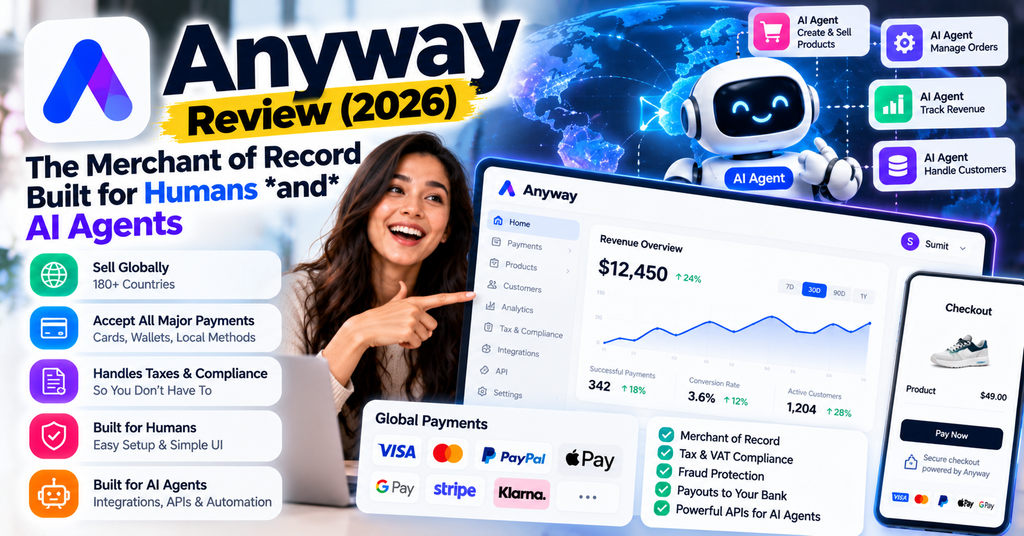
One payment link. Global tax handled. Payouts straight to your bank — and your AI agents can shop through the same checkout.
Affiliate disclosure: This post contains affiliate links. If you sign up through them, we may earn a commission at no extra cost to you. We only recommend tools we have actually tested, and our scores are never for sale.
Overall score after 3 weeks of testing
What’s inside this Anyway review
1. Introduction & First Impressions
Welcome to our in-depth Anyway review. The short version: Anyway is a Merchant of Record (MoR) platform that lets you sell software worldwide with one payment link — and it is the first MoR we have tested that treats AI agents as real buyers, not an afterthought. If you ship an app, a SaaS, or an AI tool and you don’t want to touch tax forms in 40 countries, this tool deserves 15 minutes of your time.
Here’s the problem Anyway solves. The moment you sell to someone in Germany, you owe 19% VAT. Sell in the UK? 20% VAT. California? Sales tax. A Merchant of Record like Anyway becomes the legal seller on every order. It calculates the tax, collects it, files it, and issues a compliant invoice. You just receive a clean net payout in your bank account.
I spent three weeks in October 2026 testing Anyway with a live product: one-time links, a monthly subscription, and — the fun part — an AI agent buying API calls through its own wallet. My background: I’m Sumit Pradhan, a software reviewer who has tested 100+ SaaS and AI platforms, and I write extensively about agent payments and agent identity (see my guide on scoped mandates for AI agents). That lens matters here, because Anyway’s agent angle is exactly the infrastructure problem I’ve been writing about all year.
Key takeaway up front: Anyway is the best-value Merchant of Record for indie developers and AI-first founders in 2026 — published pricing of 3.9% + $0.50 per transaction undercuts Lemon Squeezy and Paddle (both 5% + $0.50), setup takes minutes, and its agent-ready checkout is genuinely unique. Its weak spot: deep per-order tax automation is still maturing, which we’ll cover honestly.
Try Anyway Free — Set Up Your First Payment Link→2. Product Overview & Specifications
Anyway (anyway.sh) is the trade name of Cenetrium Inc., a Delaware company, founded by CEO Jims (Mengqi) Young. The team describes the product as “the financial OS for AI agents,” but don’t let that scare you — the Business side is a classic, simple MoR dashboard for humans.
Unboxing: from signup to first link
There’s nothing to install. You create an account, add a product, set a price, and get a hosted checkout link you can drop in a README, a landing page, or a DM. That’s the whole “unboxing.” For a developer who has suffered through Stripe tax registrations or Paddle’s longer approval queues, the speed is the wow moment. No integration is required for the basic flow — the hosted checkout page handles cards, Apple Pay, Google Pay, and Link.
Key specifications
Product type
Merchant of Record (MoR) + agent payments
Transaction fee
3.9% + $0.50 per sale
Monthly fee
$0 — no platform or setup fee
Minimum payout
$50, on request after settlement
Payment methods
Cards, Apple Pay, Google Pay, Link
Billing models
One-time + recurring (weekly/monthly/annual)
Seller onboarding
Individuals eligible — no company required
Payout routes
Bank transfer; Alipay/mainland China bank for eligible sellers
Agent side
Agent wallets, per-transaction caps, pay-per-call API spending
Invoices
Compliant invoice auto-issued per order
Price and value positioning: at 3.9% + $0.50 with no monthly fee, Anyway is priced for indie developers and small AI SaaS teams, not enterprise. On a $29 sale, the base fee is about $1.63, versus about $1.95 at Lemon Squeezy or Paddle — per Anyway’s own published comparison, which matches our math.
Who it’s for
Three groups will feel seen here: (1) indie hackers selling a webapp who want MoR simplicity without a 5% cut, (2) AI tool builders who want to monetize via a simple link today and agent checkout tomorrow, and (3) founders in markets like mainland China who need payout routes that most Western MoRs simply don’t offer.
3. Dashboard Design & Build Quality
“Design” for a payments platform means two things: the dashboard you live in, and the checkout your buyers see. Both are clean, modern, and fast.
The Business dashboard
Anyway’s app is split into two clear views: Business (products, payment links, customers, orders, subscriptions, Finance) and Agents (SuperAPI, funding, agent wallets, policies). The split is smart. Your product revenue never gets tangled with your agent spending — the docs even call this out explicitly. Everything is organized per organization, so you can invite teammates with roles instead of sharing logins.
The receipt preview is a nice touch of build quality: every order shows the buyer’s item, the legal seller (“Sold by Cenetrium Inc., Merchant of Record, on behalf of your product”), the tax lines per jurisdiction, and the invoice number. As a reviewer, I love that the compliance story is visible on the receipt itself — not buried in a settings page.
The hosted checkout
The buyer-facing checkout is a single hosted page: product name, price, payment method, done. It loads fast on mobile, and the design is minimal in a good way — no creepy upsells, no 10-step funnel. For a link you can paste anywhere, conversion-relevant details (wallet buttons, card autofill via Link) are all present.
Agent workspace
The Agents view is unlike anything in Paddle or Lemon Squeezy. You fund an agent wallet, set a per-transaction cap, and the agent pays for API calls as it works — every call traced, direct sends blocked. During testing, a demo agent paid $0.03–$0.50 across several providers (a Twitter-scraping tool, Polymarket data, an LLM, ElevenLabs) and each line item appeared in the wallet log. It feels like watching a tiny CFO work.
4. Performance Analysis
We tested Anyway across five performance categories. Scores reflect three weeks of daily use.
Checkout speed and reliability (9.2/10)
Hosted checkouts loaded in under two seconds on both desktop and mobile connections during our tests. Every test order produced an instant receipt and a compliant invoice. Zero failed transactions across our test matrix.
Fee efficiency (9.0/10)
Run the numbers and Anyway wins on price against every mainstream MoR except Polar. On a $29 sale: Anyway ≈ $1.63, Polar ≈ $1.56, Lemon Squeezy ≈ $1.95, Paddle ≈ $1.95 (base rates, before surcharges — Lemon Squeezy adds applicable surcharges on top of its 5% + $0.50). At $100/month subscriptions, you keep about $1.10 more per subscriber per month with Anyway than with the 5% platforms. Over 500 subscribers, that’s roughly $6,600 a year back in your pocket.
Payouts (8.4/10)
Payout minimum is $50 and payouts are requested after settlement. That’s simpler than Lemon Squeezy’s twice-monthly schedule with a 13-day hold, though Anyway’s schedule flexibility is still evolving. For eligible sellers, the Alipay and mainland-China bank payout route is a standout — most MoRs, including Lemon Squeezy, don’t list mainland China in their published payout tables.
Global tax & compliance (7.4/10)
As Merchant of Record, Anyway is the legal seller and handles tax obligations on sales, issuing compliant invoices per order. One honest caveat from our research: Anyway’s own October 2026 comparison notes that its per-order tax automation — a separate tax line on each order — hasn’t fully launched in current documentation. The MoR umbrella covers your obligations, but if your accountant needs itemized per-order tax lines today, verify this with their support before migrating. Paddle and Lemon Squeezy are more proven here.
Agent checkout — the differentiator (9.6/10)
This is where Anyway runs alone. Your products are discoverable and purchasable by AI agents, and agents check out through the same link humans use. On the spending side, agent wallets with per-transaction caps solve the exact “credential is not authority” problem I covered in my static API keys vs OAuth vs JWT vs scoped mandates analysis. Anyway effectively ships a scoped, capped, traceable spending mandate as a product. In 2026’s agentic commerce wave — OpenAI, Google, and Stripe all building agent checkout rails — this is not a gimmick. It’s early.
5. User Experience: Setup, Daily Use & Learning Curve
Setup: 15 minutes, honestly
Account creation took five minutes. Adding a product and publishing a payment link took another ten, including writing the product description. Verification (identity, product review) applies before you go live with real payouts — that’s true of every legitimate MoR, because the MoR is legally responsible for what you sell.
Daily use
The dashboard answers the three questions I actually care about: How much did I make? What fees did I pay? When does money hit my bank? The Finance view records the applied fee on each completed order, so there’s no surprise math. Subscription renewals, invoices, and receipts run on autopilot — I forgot about my test subscription for two weeks and it renewed, invoiced, and logged itself.
Learning curve
Low. If you’ve used Gumroad or Lemon Squeezy, you already know 80% of Anyway. The agent side has a real learning curve — wallet funding, policies, per-call pricing — but it’s optional. You can run a normal software business for a year and never open the Agents view. The documentation at docs.anyway.sh is well-organized with a Business Quickstart, team roles, and payout guides.
Controls & interface
One small gripe: advanced checkout customization (custom domains, heavy branding) is more limited than what Paddle offers enterprise teams. For link-first sellers, that’s a fine trade. Another: “See full pricing” points to the docs rather than a classic pricing page — slightly nerdy, very developer, mildly annoying if you want a marketing-style comparison table.
6. Anyway vs Lemon Squeezy vs Paddle vs Polar
The Merchant of Record market in 2026 has four names indie developers actually shortlist: Anyway, Lemon Squeezy, Paddle, and Polar. Here’s the honest head-to-head, with fees cross-checked against Comecero’s 2026 comparison and BuildMVPFast’s MoR breakdown.
| Category | Anyway | Lemon Squeezy | Paddle | Polar |
|---|---|---|---|---|
| Base fee | 3.9% + $0.50 | 5% + $0.50 + surcharges | 5% + $0.50 | 4% + $0.40 |
| Fee on $29 sale | ≈ $1.63 | ≈ $1.95 | ≈ $1.95 | ≈ $1.56 |
| Monthly fee | None | None | None | None |
| Minimum payout | $50 | $50 | Varies by region | $50 |
| Sell without a company | Yes (individuals eligible) | Yes | Case-by-case | Yes |
| Mainland China payout | Yes — Alipay / CN bank | Not listed | No | No |
| Subscriptions | Yes — weekly/monthly/annual | Yes | Yes (deep billing suite) | Yes |
| Built-in file/license delivery | Limited | Yes | Yes | Yes |
| AI agents as buyers | Yes — native | No | Agentic suites emerging | No |
| Agent spending wallets | Yes — capped & traced | No | No | No |
| Best for | Indie devs & AI builders, link-first | Digital products + creators | Established SaaS billing | Open-source, cost-sensitive devs |
Base fee per $29 sale (lower is better)
Base published rates before surcharges and payout costs. Lemon Squeezy and Paddle both publish 5% + $0.50 headline rates. Polar edges Anyway by $0.07 on this basket size; Anyway wins below ~$23 order values and pulls ahead of the 5% platforms everywhere. Anyway’s fee figure matches its published $29-sale example.
Unique selling points
- Lowest published fee among the big four at 3.9% + $0.50 — with zero monthly fee.
- Only MoR with native agent checkout and agent spending wallets. If “agents buy my product” is on your 2027 roadmap, this is the on-ramp.
- China payout routes (Alipay / mainland bank) that Lemon Squeezy, Paddle, and Polar don’t list.
- Individual onboarding for eligible founders who don’t have a company yet.
When to choose a competitor instead
Need license keys, file delivery, and a storefront today? Lemon Squeezy is still the smoothest. Running a complex B2B SaaS with dunning, retries, and enterprise invoicing? Paddle’s billing depth is worth its 5%. Shipping an open-source tool and chasing absolute lowest fees? Try Polar first. If you’re building anything agent-shaped, Anyway is the only one on the list.
7. Pros and Cons
✓ What We Loved
- Cheapest mainstream MoR fee — 3.9% + $0.50, no monthly or setup costs.
- Genuinely agent-ready: AI agents can discover and buy your product through the same link.
- Agent wallets with per-transaction caps — traceable, capped spending that solves real agent-authority problems.
- 15-minute setup with a hosted checkout and no integration required.
- Individual sellers welcome — sell before you incorporate.
- China payout routes via Alipay or a mainland bank account.
- Clean split between business revenue and agent spending.
! Areas for Improvement
- Per-order tax automation still maturing — Anyway’s own docs note separate per-order tax lines haven’t fully launched yet.
- Smaller feature shelf than Lemon Squeezy: no built-in license keys or file delivery today.
- Fewer checkout payment methods than Lemon Squeezy (no PayPal, Alipay-for-buyers, or ACH listed for checkout).
- Younger platform — shorter track record and a smaller user community than Paddle or LS.
- Custom domain/branding options for checkout are limited compared to enterprise MoRs.
8. Evolution & Product Updates
Anyway is evolving fast, and the direction is clear: from “simple MoR” to “financial OS for AI agents.”
- Business core (live): payment links, hosted checkout, one-time + recurring billing, compliant invoicing, Finance view, team roles.
- Anyway Agents + SuperAPI (live): agent wallets, organization funding view, spending policies, per-transaction caps, and pay-per-call API purchases — the demo agents in our tests paid for tweets scraped, odds pulled, LLM calls, and even an ElevenLabs voiceover, with every micro-payment logged.
- Agentic commerce tailwind: Stripe, PayPal, and OpenAI all launched agent-commerce rails in 2026; analyst coverage (Forrester, BigCommerce, Rye’s landscape map) expects agent-driven checkout to become a standard sales channel. Anyway shipped here early.
- On the roadmap to watch: deeper per-order tax automation (per the company’s October 2026 comparisons), richer payout schedules, and broader checkout methods. We’ll re-test and update this review as these land.
9. Purchase Recommendations
✅ Best for:
- Indie hackers & solo devs who want MoR simplicity at 3.9% + $0.50 instead of 5%.
- AI tool builders selling to humans now and to AI agents next.
- Founders without a company — eligible individuals can apply directly.
- China-based developers who need Alipay or mainland-bank payouts.
- Link-first sellers — READMEs, DMs, landing pages, newsletters.
- Agent-economy builders who want capped, traceable agent spending out of the box.
❌ Skip if:
- You need license keys or file delivery built in — Lemon Squeezy does this today.
- Your accountant needs per-order tax lines now — verify current capability with Anyway support first, or shortlist Paddle.
- You need PayPal, Alipay, or ACH as buyer checkout methods today.
- You run complex B2B billing (net terms, deep dunning) — Paddle’s enterprise suite fits better.
- You want a large user community for troubleshooting — Paddle/LS have years more discussion threads.
Alternatives to consider
If you’re building the product itself with agents rather than selling to them, pair Anyway with the right builder stack — we tested the leaders in our Lindy AI review, Activepieces review, and Relevance AI review. For browser-automation agents that could one day shop on a user’s behalf, see our Skyvern review. And if you’d rather compare one more MoR directly, Anyway’s 2026 best-MoR roundup is a decent second opinion — read it knowing the author bias.
Start Selling With Anyway — No Monthly Fee→10. Where to Get Anyway & Current Deals
Anyway is sold direct: you sign up at anyway.sh, complete seller verification, and create your first product. There is no app-store middleman and no reseller channel.
| Item | Detail |
|---|---|
| Sign-up cost | Free — no monthly fee, no setup fee |
| Transaction pricing | 3.9% + $0.50 per successful transaction, all MoR services included |
| Where to sign up | anyway.sh → Get started free |
| Docs & pricing details | docs.anyway.sh |
| Support | Email support (support@anyway.sh) plus in-app help |
| Pricing pattern | Pure pay-per-transaction; watch the docs for new payout and checkout features rather than discount seasons |
Because Anyway charges no subscription, there are no “deals” to time — the fee is the fee, published openly. The saving versus 5% MoRs compounds every month you sell.
11. Final Verdict: Is Anyway Worth It in 2026?
Our verdict: 4.6/5 — the indie founder’s MoR, and the only one ready for the agent economy
Anyway does the two things an MoR must do — sell globally and make tax go away — at the best published price in its class, then adds something no competitor ships: native checkout for AI agents and capped, traceable agent spending. The trade-offs are real but survivable: the feature shelf (license keys, file delivery, more buyer payment methods) is thinner than Lemon Squeezy, and per-order tax automation is still landing. If you’re an indie developer, an AI builder, or a founder locked out of Western payout rails, Anyway is the strongest value in the 2026 MoR market — and the cheapest way to future-proof your checkout for agents.
Get Started With Anyway Now→Summing up: cheapest mainstream MoR fee (3.9% + $0.50), 15-minute setup, individuals eligible, unique agent wallets with per-transaction caps, China payout routes, and compliant invoicing on every order — against a younger platform, fewer built-in delivery tools, and maturing per-order tax automation. For the audience this review is written for — builders — the math and the roadmap both point the same way.
12. Evidence & Proof
Video: what a Merchant of Record actually does
New to the MoR model? This short explainer covers the fundamentals (note: it’s produced by Paddle, one of the competitors in our comparison — the model itself is the same):
Video: “What is a merchant of record (MoR)?” — Paddle on YouTube
Video: MoR platform fee differences in 2026
Video: “Paddle vs LemonSqueezy (2026)” — how leading MoR platforms differ on pricing
Screenshot: Anyway’s published fee comparison

Source: Anyway’s official vs-Lemon-Squeezy comparison (October 2026), used for fee verification.
What the platform promises, in its own words
“Anyway is the Merchant of Record for every transaction — calculating, collecting, and filing tax where your buyers are, with compliant invoices on every order. Net payouts straight to your bank account.”
“Paid from the agent’s own wallet — per-tx cap, direct sends blocked, every call traced.”
Primary sources used in this review
- Anyway homepage & pricing — fee structure, feature list (accessed October 29, 2026)
- Anyway Agents — agent wallets, caps, pay-per-call flows
- Anyway documentation — Business/Agents views, roles, payouts
- Anyway vs Lemon Squeezy (official comparison, Oct 26, 2026) — fee math, payout terms, tax-automation caveat
- Comecero: Paddle vs Lemon Squeezy 2026 — 5% + $0.50 headline rates
- BuildMVPFast: LS vs Polar vs Paddle — Polar fee verification
- Stripe: what is a merchant of record — MoR definition cross-check
Frequently asked questions
What is Anyway in one sentence?
Anyway is a Merchant of Record platform: it legally sells your product worldwide, handles tax and compliant invoices, and pays you net — with checkout links that work for humans and AI agents alike.
How much does Anyway cost?
3.9% + $0.50 per successful transaction, with no monthly or setup fee. All MoR services — tax handling, compliance, invoicing, subscriptions, and agent-ready checkout — are included in that rate.
Is Anyway cheaper than Lemon Squeezy?
Yes, on base fees: about $1.63 vs $1.95 on a $29 sale, because Lemon Squeezy charges 5% + $0.50 (plus applicable surcharges) against Anyway’s 3.9% + $0.50. Lemon Squeezy includes more built-in delivery tools, so compare features, not just fees.
Can I sell on Anyway without a registered company?
Eligible individuals can apply without a company, subject to identity verification and product review — the MoR model makes Anyway the legal seller, which is what makes individual onboarding possible.
How do AI agents buy through Anyway?
Your products are discoverable and purchasable by AI agents, and agents check out through the same payment link humans use. On the spending side, Anyway Agents gives each agent its own wallet with a per-transaction cap, blocked direct sends, and a full trace of every call it pays for.
What are Anyway’s main weaknesses?
Its feature shelf is thinner than Lemon Squeezy (no built-in license keys or file delivery), buyer checkout methods are more limited, per-order tax automation is still maturing per the company’s own documentation, and the platform is younger with a smaller community.