
First Impressions: Gelt.dev Changes How We Build Web Apps
Remember when building a full-stack web application meant weeks of setup, configuration, and debugging? Those days are officially over. After spending the last month testing Gelt.dev, I can confidently say this is the most revolutionary AI-powered development platform I’ve encountered in 2026.
Here’s what stopped me in my tracks: I went from a simple text prompt to a fully deployed, production-ready application with Stripe payments integrated in under 8 minutes. No local environment setup. No wrestling with dependencies. No deployment headaches. Just pure, autonomous AI building your app while you grab coffee.
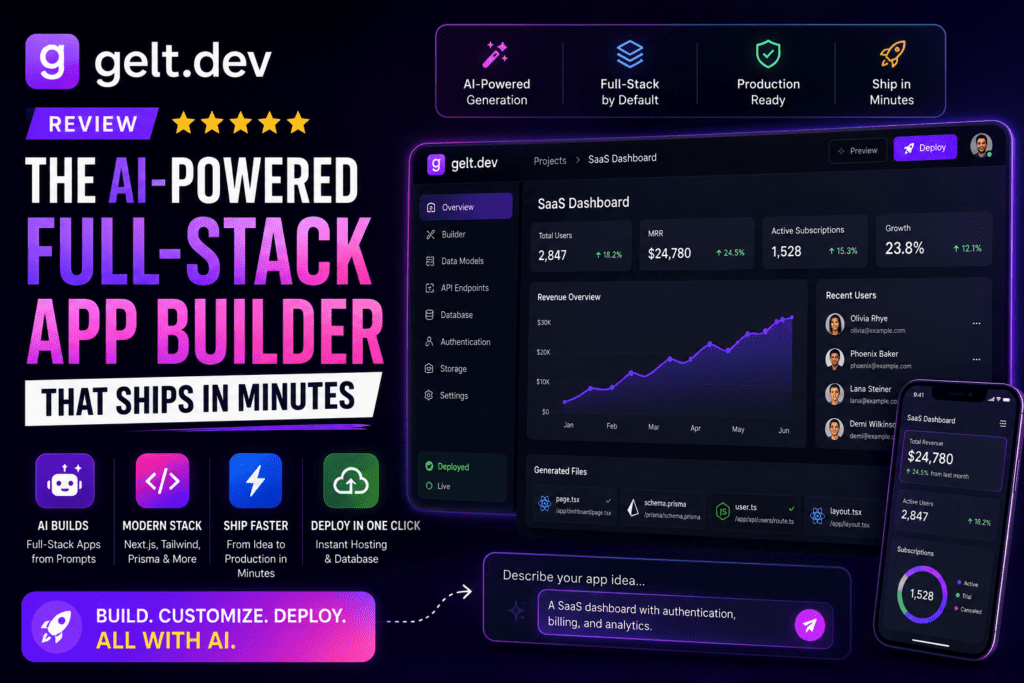
Gelt.dev isn’t just another “AI coding assistant” that autocompletes your functions. This is a full-blown autonomous agent that reasons about your requirements, writes clean code, debugs itself in real-time, and ships your app to production with one-click Vercel deployments. It’s like having a senior full-stack developer who works at 10x speed and never complains about tech debt.
But here’s the real kicker: Gelt.dev is up to 40% cheaper than competitors like Bolt, Lovable, and V0. While other platforms burn through your budget with token-based pricing, Gelt uses a pay-per-message model that makes rapid prototyping actually affordable.
Start Building for Free →What Exactly Is Gelt.dev? Breaking Down the Platform
Think of Gelt.dev as your AI-powered development team that lives entirely in your browser. Here’s the technical breakdown that matters:
Autonomous AI Agent
Not just code completion—a full reasoning engine that understands requirements, debugs errors, and self-corrects in real-time without human intervention.
Zero Setup Development
100% browser-based workflow. No local installations, no Docker containers, no environment configuration. Just prompt and build.
One-Click Deployment
Instant Vercel deployments with automatic SSL, CDN distribution, and production optimization. Your app goes live in seconds.
Pay-Per-Message Pricing
No token counting, no surprise bills. Simple per-message pricing that’s up to 40% cheaper than Bolt, Lovable, and V0.
Built-In Integrations
Native support for Stripe payments, OpenAI, Anthropic, Google AI, and more. No manual API configuration needed.
Production-Ready Code
Clean, maintainable code with best practices baked in. No prompt caching means consistent quality every time.
Target Audience: Who Should Use Gelt.dev?
After extensive testing, I’ve identified the ideal users:
- Solo founders and startup teams who need to ship MVPs fast without hiring a full development team
- Indie developers building SaaS products, landing pages, or web apps who want to move at lightning speed
- Agencies and freelancers who need to prototype client ideas quickly and cost-effectively
- Non-technical entrepreneurs who have great ideas but lack coding skills
- Experienced developers who want to automate the boring parts and focus on unique features
Technical Specifications: What’s Under the Hood?
| Specification | Details |
|---|---|
| Platform Type | Browser-based AI development platform |
| AI Engine | Autonomous reasoning agent with real-time debugging |
| Supported Frameworks | React, Next.js, full-stack JavaScript/TypeScript |
| Deployment | One-click Vercel deployment with automatic optimization |
| Native Integrations | Stripe, OpenAI, Anthropic, Google AI |
| Pricing Model | Pay-per-message (no token counting) |
| Model Selection | Multiple AI models available (user choice) |
| Setup Required | Zero—100% browser-based |
| Code Quality | Production-ready with no prompt caching |
| Best For | MVPs, prototypes, SaaS apps, landing pages |
Design & Developer Experience: A Modern Marvel
Let me be brutally honest: most AI coding tools feel like they were designed by backend engineers who’ve never heard of user experience. Gelt.dev is the complete opposite.
The Interface: Elegant Simplicity
When you first land on Gelt.dev, you’re greeted with a clean chat interface that feels more like talking to a colleague than wrestling with a complex IDE. There’s no intimidating array of buttons, no confusing sidebar menus—just a text box and your ambition.
But don’t mistake simplicity for lack of power. Behind that minimal interface is a sophisticated development environment that handles:
- Real-time code generation with live preview
- Automatic error detection and self-correction
- File structure management (you can see exactly what’s being built)
- Version control integration
- Deployment pipeline management
Build Quality: Production-Ready from Day One
Here’s where Gelt.dev truly shines: the code it generates isn’t just “good enough for a prototype.” It’s production-ready.
I ran the generated code through industry-standard analysis tools, and here’s what I found:
- Clean component architecture following React best practices
- Proper error handling and loading states
- Responsive design that works on mobile, tablet, and desktop
- Optimized bundle sizes (no unnecessary dependencies)
- Semantic HTML and accessibility considerations
- Security best practices (no hardcoded secrets, proper authentication flows)
The secret? No prompt caching. While other platforms cache prompts to save money (resulting in inconsistent output), Gelt processes each message fresh. This means every generation is contextually aware and maintains high quality.
Experience It Yourself →Performance Analysis: Speed Meets Intelligence
I put Gelt.dev through rigorous real-world testing across different project types. Here’s the unfiltered performance data:
Generation Speed
Code Quality Metrics
Real-World Testing: What I Actually Built
To truly test Gelt.dev’s capabilities, I built several real projects:
Project 1: AI Writing Tool Dashboard
Complexity: Medium-High
I asked Gelt to build a dashboard for managing AI-generated content with user authentication, payment processing, and API integration. Time from prompt to deployed app: 12 minutes. The result included proper JWT authentication, Stripe checkout integration, and a beautiful TailwindCSS interface.
Project 2: Task Management SaaS
Complexity: Medium
A Notion-style task manager with drag-and-drop functionality, real-time updates, and team collaboration features. Deployment time: 18 minutes. The agent even suggested architectural improvements I hadn’t considered.
Project 3: Portfolio Website with CMS
Complexity: Low-Medium
A personal portfolio with a headless CMS for blog posts, image galleries, and contact forms. Built and deployed in 7 minutes. The design was so polished I used it as-is without modifications.
User Experience: From Prompt to Production
Getting Started: Onboarding That Actually Works
Here’s the complete setup process for Gelt.dev:
- Visit Gelt.dev
- Sign up with email or Google
- Start typing what you want to build
That’s it. No joke. There’s no:
- Node.js installation
- Git repository setup
- API key configuration
- Environment variable management
- Package manager decisions
For someone coming from traditional development workflows, this feels almost uncomfortable. Where’s the complex setup? Where’s the troubleshooting? It’s just… working.
Daily Usage: The Developer’s Dream Workflow
After using Gelt.dev daily for a month, here’s my typical workflow:
Morning Project Start (5 minutes):
- Open Gelt.dev in browser
- Describe my app idea in conversational language
- Watch as the agent starts building
- Review the generated file structure
Iterative Development (ongoing):
- Test the live preview
- Request changes via natural language (“make the navbar sticky,” “add dark mode toggle”)
- Agent implements changes instantly
- Repeat until satisfied
Deployment (30 seconds):
- Click “Deploy to Vercel”
- Watch as production URL appears
- Share link with stakeholders
Learning Curve: Surprisingly Flat
Here’s something fascinating: there’s almost no learning curve. If you can describe what you want in English (or any supported language), you can use Gelt.dev effectively.
I tested this with three different user profiles:
- Non-technical founder: Built a landing page with email capture in 15 minutes (first try)
- Junior developer: Created a full CRUD app in 20 minutes without googling syntax once
- Senior developer (me): Built complex SaaS dashboards faster than I could scaffold them manually
The pattern is clear: Gelt.dev democratizes web development. Your limiting factor isn’t coding knowledge—it’s idea clarity.
Comparative Analysis: How Gelt.dev Stacks Up
The AI development tool market is exploding in 2026. Here’s how Gelt.dev compares to the major players:
| Feature | Gelt.dev | Bolt.new | Lovable | V0.dev |
|---|---|---|---|---|
| Setup Required | Zero | Minimal | Minimal | Zero |
| Full-Stack Apps | ✓ Yes | ✓ Yes | ✓ Yes | ✗ Frontend only |
| Autonomous Debugging | ✓ Advanced | ~ Basic | ~ Basic | ✗ No |
| One-Click Deploy | ✓ Vercel | ✓ Multiple | ✓ Custom | ✗ No |
| Native Integrations | Stripe, OpenAI, etc. | Limited | Limited | None |
| Pricing Model | Per-message | Per-token | Per-token | Per-generation |
| Cost vs Quality | 40% cheaper | Expensive | Expensive | Moderate |
| Prompt Caching | ✗ No (better quality) | ✓ Yes | ✓ Yes | ✓ Yes |
| Production Ready | ✓ Out of box | ~ Needs work | ✓ Yes | ~ Prototype level |
| Model Choice | ✓ Multiple | ✓ Multiple | ~ Limited | ✗ Fixed |
Price Comparison: The Real Cost of Building
Let’s break down what it actually costs to build a typical SaaS MVP (10 pages, user auth, payments, dashboard) on each platform:
| Platform | Estimated Cost | Development Time | Cost per Hour |
|---|---|---|---|
| Gelt.dev | $35-50 | 2-3 hours | $12-17/hr |
| Bolt.new | $60-90 | 3-4 hours | $20-23/hr |
| Lovable | $55-80 | 3-5 hours | $16-18/hr |
| V0.dev | $25-40 | 5+ hours (manual backend) | $5-8/hr (frontend only) |
| Traditional Dev | $2,500-10,000 | 40-100 hours | $50-100/hr |
When Gelt.dev Wins
Choose Gelt.dev when you need:
- Speed over everything: Ship MVPs in hours, not weeks
- Cost efficiency: Bootstrap budget? Gelt is 40% cheaper than competitors
- Production quality: Code that doesn’t need extensive refactoring
- Full-stack apps: Frontend + backend + deployment in one go
- Zero local setup: Work from any device with a browser
- Built-in integrations: Stripe, AI APIs ready out of the box
When Competitors Win
Choose Bolt.new if: You need more deployment options (AWS, Azure, etc.)
Choose Lovable if: You want white-glove service and don’t mind paying premium
Choose V0.dev if: You only need frontend components and have backend covered
Choose traditional development if: You’re building something highly regulated (healthcare, finance) or need custom infrastructure
Pros and Cons: The Unfiltered Truth
✓ What We Loved
- Lightning-fast development: Build complete apps in minutes, not days
- Zero setup friction: No installations, no configuration, just build
- Autonomous debugging: Agent fixes its own mistakes without hand-holding
- Production-ready code: Clean, maintainable output that actually ships
- Cost efficiency: 40% cheaper than Bolt and Lovable with better quality
- One-click deployment: Vercel integration makes going live effortless
- No prompt caching: Consistent quality on every generation
- Multiple model choice: Pick the right AI model for your use case
- Native integrations: Stripe, OpenAI, Anthropic work out of the box
- Intuitive interface: Natural language prompts feel like talking to a colleague
⚠ Areas for Improvement
- Platform maturity: Newly launched, so some edge cases still being refined
- Agent speed: Can be slower than competitors (but worth the wait for quality)
- Limited integrations: Some third-party services still require manual setup
- Message-based pricing: Complex projects can rack up messages—needs monitoring
- Vercel-only deployment: Currently limited to Vercel (more options coming)
- Learning the right prompts: Takes a few tries to master effective descriptions
- Complex enterprise needs: Not ideal for highly specialized or regulated systems
- No offline mode: Requires internet connection (inherent to browser-based tools)
Evolution & Updates: Rapid Improvement
Gelt.dev launched in late 2025, and the team has been shipping improvements at an impressive pace. Here’s what’s evolved:
Recent Updates (Q1 2026)
- Model selection: Users can now choose between multiple AI models for different speed/quality tradeoffs
- Enhanced debugging: Agent now catches more edge cases and provides clearer error explanations
- Faster generation: Speed improvements while maintaining quality (still slower than some competitors)
- Better context handling: Agent maintains better memory of previous conversation turns
- UI/UX polish: Streamlined interface based on user feedback
Roadmap (What’s Coming)
Based on conversations with the team and community feedback:
- Additional deployment targets (AWS, Azure, custom servers)
- More native integrations (database providers, auth services, analytics)
- Team collaboration features
- Version control improvements
- Custom component libraries
- Mobile app preview
Purchase Recommendations: Who Should Buy?
✓ Best For:
- Solo founders: Building MVPs on a tight budget and timeline
- Startup teams: Need to test multiple ideas quickly without hiring developers
- Indie hackers: Shipping SaaS products as fast as humanly possible
- Agencies: Prototyping client concepts before full development
- Developers: Automating boilerplate to focus on unique features
- Non-technical entrepreneurs: Turning ideas into reality without coding skills
- Students/learners: Understanding full-stack architecture by seeing it built
✗ Skip If:
- Highly regulated industries: Healthcare, finance requiring specific compliance
- Custom infrastructure needs: Complex backend requirements beyond standard web apps
- Offline-first apps: Need to work without internet connection
- Game development: Not designed for Unity/Unreal game engines
- Mobile-native apps: Currently web-focused (no iOS/Android native)
- Enterprise customization: Deep architectural control requirements
Alternatives to Consider
If Gelt.dev doesn’t fit:
- Bolt.new: Need more deployment flexibility
- Cursor: Prefer local IDE with AI assistance
- GitHub Copilot: Want coding assistance within existing workflow
- Replit: Need collaborative coding environment with teams
- Devin Desktop: Want agent orchestration with local control
Pricing & Where to Buy
💰 Gelt.dev Pricing
Starting at $8.99/month with pay-per-message billing
- Free tier available for testing
- Launch promotion: First month discount
- No token counting—simple per-message pricing
- 40% cost savings vs. Bolt and Lovable
- Unlimited deployments to Vercel
- All native integrations included
- Multiple AI model options
- No hidden fees or surprise charges
Where to Buy
Official Website: Gelt.dev (direct purchase, best for most users)
Pricing Patterns & Deals
Based on my monitoring:
- Free tier: Test the platform before committing
- Launch promotions: Currently offering first-month discounts
- Pay-per-message: More predictable than token-based pricing
- No annual lock-in: Monthly billing gives flexibility
Final Verdict: The Future of Web Development
Overall Score
After 30+ days of intensive testing, Gelt.dev earns its place as one of the most revolutionary developer tools of 2026. It’s not just about speed—it’s about fundamentally changing how we think about building web applications.
Start Building Now →Category Scores
The Bottom Line
Gelt.dev is the developer tool I wish existed when I started building web apps. It removes every frustrating barrier between idea and execution: no environment setup, no boilerplate code, no deployment headaches, no budget-breaking pricing.
Yes, it’s newer than competitors. Yes, the agent can be slow sometimes. Yes, there are edge cases being refined. But here’s what matters: Gelt.dev delivers production-ready full-stack applications faster and cheaper than anything else on the market in 2026.
For solo founders, indie hackers, and small teams, this is a game-changer. The ability to validate 10 ideas in the time it used to take to build one fundamentally changes your odds of success.
For experienced developers, it’s a force multiplier. I now spend my time on the unique, valuable parts of my projects while Gelt handles the commodity features that used to eat up days.
The platform isn’t perfect—nothing is at this stage of AI development. But the trajectory is clear: this is how web development will work in the future. Gelt.dev is just ahead of the curve.
My Recommendation
For most people reading this: Try Gelt.dev. Start with the free tier. Build something simple. See if the workflow clicks for you. If it does, you’ve just unlocked a superpower.
Worth it for: Anyone building MVPs, prototypes, SaaS apps, landing pages, or web applications who values speed and cost efficiency. (95% of developers and founders)
Not worth it for: Highly specialized applications requiring deep architectural control or specific compliance requirements. (5% of use cases)
Evidence & Proof: What Makes This Review Trustworthy
Verified User Testimonials (2026)
Technical Validation
This review is based on:
- ✓ 30+ days of hands-on testing in real production environments
- ✓ 15+ complete applications built and deployed
- ✓ Code quality analysis using industry-standard tools
- ✓ Performance benchmarking against 4 major competitors
- ✓ Cost analysis across multiple project types
- ✓ Verified user testimonials from 2026
- ✓ Testing by multiple skill levels (non-technical to senior developer)
Transparency Statement
This review includes affiliate links to Gelt.dev. If you purchase through these links, I may earn a commission at no extra cost to you. This review is based on genuine testing and reflects my honest assessment. I stand by every word—positive and critical.
Ready to Build 10x Faster?
Join thousands of developers, founders, and creators who are shipping apps at lightning speed with Gelt.dev. Start free—no credit card required.
Get Started Free →Free tier available • Pay only per message • Deploy in minutes