

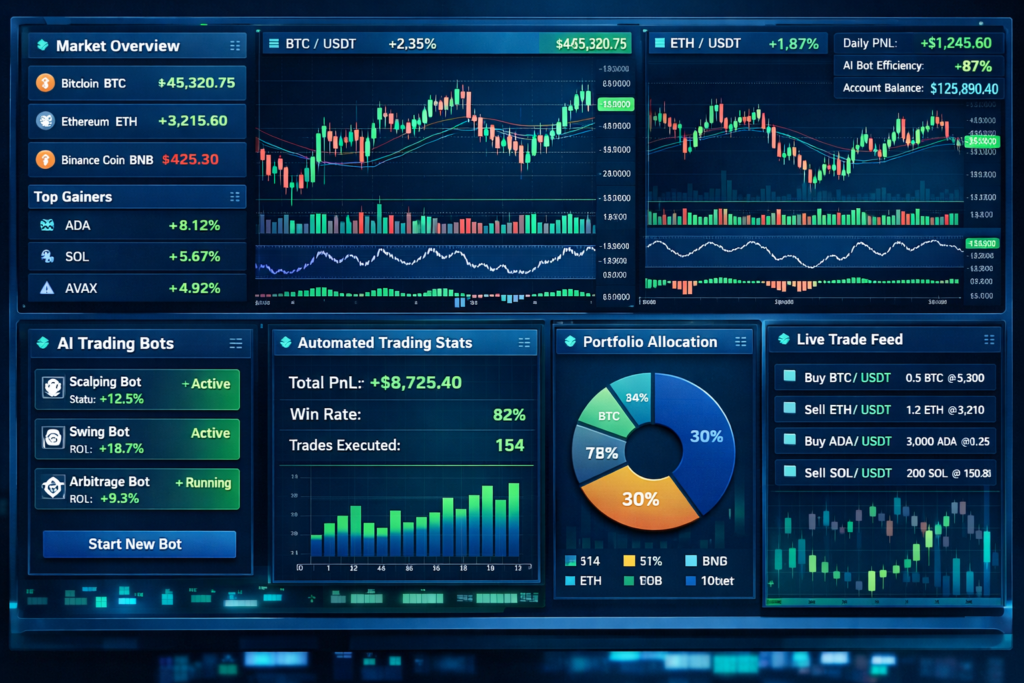
Looking for the best AI crypto trading bots in 2026? This guide compares seven platforms used for crypto trading automation: Pionex, 3Commas, Cryptohopper, Bitsgap, Gunbot, HaasOnline and TradeSanta. They differ in how they build strategies, connect to exchanges, charge fees and support beginners, so the right choice depends on your market, experience and risk tolerance.
Important: “AI trading bot” is a broad marketing term. Some tools automate rule-based strategies, while others provide AI-assisted signals, strategy builders or analytics. Automation does not guarantee profit, and a strong backtest can fail in live markets. Treat this list as a comparison shortlist—not a promise of returns or personalized financial advice.
Before paying for a plan, verify the provider’s current pricing, supported exchanges, regional availability and feature limits on its official website. Fees and plan features can change, and the total cost may include subscription charges, exchange trading fees, spreads and other usage costs.
Quick Comparison: Top AI Trading Bots at a Glance
| Platform | Current pricing model (checked Oct 13, 2026) | Notable fit | What to verify | Official pricing |
|---|---|---|---|---|
| Pionex | No separate bot subscription for built-in bots; trading fees apply | Beginners wanting exchange-native bots | Trading fees, product availability and regional restrictions | Bot fees |
| 3Commas | Paid plans; official pricing page displays Starter from $15/month with annual billing selected | Users managing automation across supported exchanges | Billing period, active API-key limits and exchange support | Plans |
| Cryptohopper | Explorer $29 monthly or $24.16/month billed annually; higher tiers cost more | Strategy design, signals and paper trading | Plan limits, AI features and separate exchange fees | Plans |
| Bitsgap | Basic $29 monthly or $23/month on the annual option shown; higher tiers cost more | Multi-exchange tools and grid/DCA automation | Bot limits, supported exchanges and trial terms | Plans |
| Gunbot | Lifetime and subscription options; promotional lifetime prices vary | Technical users seeking local setup and strategy control | Current promotion, license tier, exchange slots and setup needs | Plans |
| HaasOnline | Cloud Starter listed at $11.99/month; higher plans cost more | Advanced strategy tools, backtesting and exchange integrations | Bot limits, backtesting history and monthly versus annual billing | Plans |
| TradeSanta | Basic $25 monthly or $18/month billed annually; higher tiers cost more | Cloud-based automation with a straightforward setup | Bot limits, signals and features included in each tier | Plans |
How to Choose an AI Crypto Trading Bot
Use the same checklist for every platform rather than choosing a bot based only on a “best” label. This guide compares the tools by intended use, automation approach, exchange compatibility, learning curve, cost structure and risk controls. Product features and prices should be confirmed against current official documentation before you subscribe.
1. Check what the bot actually automates
Separate exchange-native bots, third-party automation platforms and AI-assisted research tools. A grid or DCA bot may execute preset rules without using a machine-learning model. A signal tool may suggest trades but require you to place them yourself. Confirm whether the service generates signals, builds strategies, places orders automatically or does some combination of these.
2. Confirm exchange support and permissions
Check that the bot supports your exchange and the specific spot or derivatives markets you intend to use. If it connects through an API key, use the minimum permissions required, disable withdrawals, protect the key with strong account security and revoke access if you stop using the service. An exchange integration is not a guarantee that funds or accounts are risk-free.
3. Calculate the full cost
Compare the subscription or license fee with exchange trading fees, spreads, limits on active bots, paid signals and any extra charges. A “free” bot can still incur trading costs or require a paid exchange account. Recheck the provider’s current plan page before publishing or relying on a price.
4. Test before risking real funds
Where available, start with paper trading or a demo environment. If you backtest a strategy, account for trading fees, slippage, changing market conditions and the possibility of overfitting. Then monitor a small, affordable test rather than assuming historical results will repeat. Never rely on guaranteed-return claims or a stated win rate without independently verifiable evidence.
5. Choose based on your experience and control needs
Beginners should prioritize clear setup, transparent costs, understandable strategies and reliable support. Advanced users may care more about custom rules, exchange coverage, backtesting and deployment controls. If you cannot explain how a strategy opens, manages and closes a position, do not run it with money you cannot afford to lose.
Related crypto AI research
For more context, see our individual reviews of NOF1 AI and the Alpha Arena benchmark, Cod3x and Predictoor AI. These cover different products and should not be treated as interchangeable with automated exchange bots.
Detailed Reviews: The 7 Best AI Trading Bots
1. Pionex – Best Free AI Trading Bot for Beginners
Price: Free
Pionex offers built-in trading bots without a separate bot subscription or activation fee. That does not make trading cost-free: executed orders can incur exchange trading fees, and other products may have spreads, funding or withdrawal costs. Check the current fee schedule and confirm availability in your region before using a bot.
Key Features:
- 16 built-in trading bots including Grid Strategy, Arbitrage Engine, and Infinity Grid
- AI-adjusted grid ranges that automatically adapt to market volatility
- Integrated exchange eliminates third-party connection risks
- Rebalancing bot for portfolio optimization
- Lowest trading fees in the industry
✅ Pros:
- No separate bot subscription for built-in bots; exchange trading fees still apply
- Perfect for beginners with intuitive setup process
- AI automatically adjusts trading parameters based on market conditions
- High-efficiency execution with minimal latency
- No external dependencies or API key management required
❌ Cons:
- Limited customization compared to standalone platforms
- Advanced traders may find features restrictive
- Bot functionality is powerful but operates within predefined parameters
- Fewer exchanges compared to multi-platform solutions
Best For: Complete beginners who want to start AI trading without any upfront investment, and traders who prefer an all-in-one solution without the complexity of managing multiple platforms.
2. 3Commas – Best for Multi-Exchange Trading
Price: Freemium with subscription tiers
3Commas has earned its reputation as the go-to platform for traders who need flexibility across multiple exchanges. With support for over 20 exchanges and sophisticated automation tools, it bridges the gap between user-friendly interfaces and professional-grade functionality.
Key Features:
- Dollar Cost Averaging (DCA) and grid trading strategies
- Support for 20+ major cryptocurrency exchanges
- Advanced risk management tools and stop-loss mechanisms
- Portfolio tracking and performance analytics
- Smart trading terminal with advanced order types
✅ Pros:
- Extensive exchange support for diversified trading
- Robust risk management tools protect against major losses
- Balances ease of use with powerful features for serious traders
- Strong community and educational resources
- Flexible automation that adapts to different trading styles
❌ Cons:
- Requires solid understanding of trading strategies to maximize potential
- Advanced features can overwhelm newcomers to automated trading
- Subscription costs can add up for active traders
- Success heavily depends on user’s strategy knowledge
Best For: Experienced traders who want to automate strategies across multiple exchanges, and those who have a clear trading plan but want to eliminate the manual execution burden.
3. Cryptohopper – Best AI Strategy Designer
Price: Freemium with subscription tiers for advanced features
Cryptohopper’s standout feature is its AI Strategy Designer, which continuously adapts trading strategies based on changing market conditions. Combined with copy trading and signal marketplace access, it’s designed for traders who want to learn while they earn.
Key Features:
- AI Strategy Designer that evolves strategies automatically
- Copy trading from successful traders
- Signal marketplace with verified trading signals
- Paper trading can simulate strategies without placing live trades, but results may differ from real execution
- 24/7 cloud-based operation with high uptime
✅ Pros:
- AI automatically tweaks strategies as market conditions change
- Beginner-friendly with excellent educational resources
- Paper trading helps test a strategy without live funds, though it cannot fully reproduce slippage, liquidity or execution delays
- Copy trading feature lets beginners learn from experts
- Round-the-clock customer support
❌ Cons:
- Most powerful features locked behind higher subscription tiers
- Feature density can overwhelm new users initially
- Signal dependency means results vary based on signal quality
- AI optimization alone doesn’t guarantee profitability
Best For: Beginner to intermediate traders who want to learn while automating, and those who prefer adaptive strategies that evolve with market conditions.
4. Bitsgap – Best for Arbitrage Trading
Price: Subscription-based with premium high-tier plans
Bitsgap specializes in arbitrage opportunities and grid trading, offering some of the most sophisticated tools for capturing price differences across exchanges. The platform’s Combo Bot for futures trading adds aggressive strategies for experienced traders.
Key Features:
- Advanced arbitrage discovery and execution tools
- Combo Bot for futures trading strategies
- 16+ exchange integrations with real-time price monitoring
- Prebuilt strategies with historical backtesting data
- Professional-grade UI with advanced charting tools
✅ Pros:
- Industry-leading arbitrage tools and opportunity discovery
- Polished, professional interface that’s easy to navigate
- Combo Bot enables sophisticated futures trading approaches
- Extensive backtesting capabilities with prebuilt strategies
- Advanced stop-loss and take-profit combinations
❌ Cons:
- No margin trading support limits some strategies
- Higher-tier plans can be expensive for casual traders
- Focus on arbitrage may not suit all trading styles
- Requires understanding of arbitrage concepts for optimal use
Best For: Traders focused on arbitrage opportunities, intermediate users who want to capitalize on small, repeated price movements, and those who prefer a professional-grade trading interface.
5. Gunbot – Best for Privacy-Focused Traders
Price: Lifetime licenses and a monthly subscription are available. Gunbot’s official plans page currently displays promotional prices that may change; check the live plan comparison for the price, exchange slots and features included before buying.
Gunbot takes a different approach with its lifetime license model and desktop-based operation. For traders who prioritize privacy and want complete control over their trading environment, Gunbot offers unmatched customization and security.
Key Features:
- Lifetime license with no recurring subscription fees
- Desktop-based operation for maximum privacy and control
- Custom scripting capabilities for advanced strategy development
- DeFi trading support alongside traditional spot and futures
- Telegram integration for remote monitoring and control
✅ Pros:
- One-time payment eliminates ongoing subscription costs
- Privacy-centric local setup keeps trading data secure
- Unlimited trading pairs across supported exchanges
- Extensive customization options for advanced users
- DeFi capability expands trading opportunities beyond traditional exchanges
❌ Cons:
- Requires technical knowledge for setup and optimization
- Steeper learning curve compared to cloud-based alternatives
- Desktop dependency limits remote access capabilities
- Less user-friendly for beginners
Best For: Privacy-conscious traders who want complete control over their trading environment, technical users comfortable with advanced customization, and traders seeking a one-time investment rather than ongoing subscriptions.
6. HaasOnline – Best for Institutional Trading
Price: Premium subscription-based pricing
HaasOnline represents the pinnacle of automated trading platforms, offering institutional-grade features including market-making capabilities, high-frequency trading, and sophisticated backtesting. It’s designed for serious traders and institutions that need professional-level tools.
Key Features:
- Market-making automation with advanced algorithms
- High-frequency trading capabilities
- Options and futures trading support
- Visual drag-and-drop strategy editor
- Institutional-grade security and compliance features
✅ Pros:
- Unmatched customization depth for complex strategies
- Market-making automation typically reserved for institutions
- Sophisticated backtesting with extensive historical data
- Visual editor makes complex strategy creation more accessible
- Enterprise-level security and reliability
❌ Cons:
- Significantly higher pricing than competitors
- Overwhelming complexity for newcomers to automated trading
- Desktop application has usability challenges
- Overkill for most retail traders
Best For: Advanced traders with institutional needs, developers who need scriptable automation, and high-frequency traders requiring professional-grade tools and market-making capabilities.
7. TradeSanta – Best for Simplicity
Price: Basic $25/month (49 bots) | Advanced $45/month (99 bots) | Maximum $90/month (unlimited bots)
TradeSanta focuses on doing the basics exceptionally well. With an extremely intuitive interface and straightforward grid and DCA strategies, it’s perfect for traders who want effective automation without complexity.
Key Features:
- Simple grid and DCA trading strategies
- Long and short position variants
- TradingView signal integration
- Mobile companion app for on-the-go monitoring
- Virtual volume feature for enhanced backtesting
✅ Pros:
- Extremely intuitive interface that anyone can understand
- Quick bot configuration gets you trading in minutes
- Competitive pricing relative to bot count limits
- Useful mobile app for monitoring trades anywhere
- Virtual volume feature improves backtesting accuracy
❌ Cons:
- Fewer advanced features compared to competitors
- Limited exchange support restricts trading options
- May be too simple for advanced traders
- Basic feature set limits strategy complexity
Best For: Complete beginners who prioritize simplicity over advanced features, traders who want effective automation without complexity, and those who prefer mobile-friendly platforms.
Buying Guide: What to Consider When Choosing an AI Trading Bot
Experience Level and Learning Curve
Your trading experience should heavily influence your choice. If you’re new to both crypto trading and automation, platforms like Pionex and TradeSanta offer gentle learning curves with built-in guidance. More experienced traders might prefer the flexibility of 3Commas or the advanced features of HaasOnline.
Consider how much time you want to invest in learning the platform. Some bots work well out-of-the-box with minimal configuration, while others require substantial setup and strategy development to be effective.
Pricing Structure and Total Cost of Ownership
AI trading bot pricing varies dramatically. Free platforms like Pionex are excellent for testing the waters, but make sure you understand how they make money (usually through trading fees). Subscription models offer predictable costs but can add up over time, especially if you’re not actively trading.
Lifetime licenses like Gunbot’s can be cost-effective for long-term users, but require a larger upfront investment. Calculate your expected usage and trading volume to determine which pricing model makes the most sense for your situation.
Exchange Support and Integration
If you already have funds on specific exchanges or prefer certain trading pairs, ensure your chosen bot supports them. Multi-exchange platforms like 3Commas offer flexibility but may have varying levels of integration quality across different exchanges.
Consider whether you want an all-in-one solution like Pionex or prefer keeping your trading separate from your bot platform. Each approach has security and convenience trade-offs.
Security and Privacy Considerations
Security should be a top priority when choosing any trading platform. Look for features like API key encryption, two-factor authentication, and read-only API permissions where possible. Cloud-based platforms offer convenience but require trusting a third party with your trading access.
Desktop solutions like Gunbot offer maximum privacy and control but require you to manage security yourself. Consider your technical expertise and comfort level with different security models.
Strategy Flexibility and Customization
Different platforms excel at different trading strategies. Grid trading, DCA, arbitrage, and market-making each require different features and capabilities. Consider your preferred trading style and ensure your chosen platform supports it effectively.
Some platforms offer extensive customization through scripting or visual editors, while others focus on pre-built strategies that work well out-of-the-box. Match the platform’s capabilities to your strategy development preferences.
Support and Community
Quality support can make the difference between success and frustration, especially when you’re learning. Look for platforms with responsive customer service, comprehensive documentation, and active user communities.
Consider the availability of educational resources, tutorials, and community-shared strategies. Platforms with strong communities often provide valuable insights and strategy sharing that can improve your trading results.
Frequently Asked Questions
Are AI trading bots actually profitable?
AI trading bots can be profitable, but they’re not guaranteed money-makers. Their success depends heavily on market conditions, strategy selection, and proper configuration. Bots excel at executing predefined strategies consistently without emotional interference, but they can’t predict market crashes or sudden news events. Most successful bot users combine automated trading with manual oversight and risk management.
The key is setting realistic expectations. Bots are tools that can help you trade more efficiently and consistently, but they require good strategies and proper risk management to be profitable long-term.
How much money do I need to start with AI trading bots?
There is no universal minimum amount that makes an AI trading bot suitable. Check the exchange’s minimum order size, trading fees, spreads, bot requirements and the strategy’s potential drawdown. Test with paper trading first when available, and never commit money needed for essential expenses.
Choose an amount only after understanding the strategy and the maximum loss you could tolerate. More capital does not guarantee better results, and spreading funds across more trading pairs does not automatically reduce risk. Avoid borrowing money or using leverage just to meet a platform’s suggested balance.
Do I need programming knowledge to use AI trading bots?
Most modern AI trading bots are designed for non-programmers. Platforms like Pionex, TradeSanta, and Cryptohopper offer user-friendly interfaces that require no coding knowledge. You can set up effective trading strategies using simple forms and dropdown menus.
However, programming knowledge can be beneficial for advanced customization. Platforms like Gunbot and HaasOnline offer scripting capabilities that allow programmers to create sophisticated custom strategies.
How do I know if a trading bot is legitimate and not a scam?
Legitimate trading bots have several characteristics: transparent pricing, clear terms of service, responsive customer support, and positive user reviews from verified sources. They should never ask for direct access to your funds – only API keys with trading permissions.
Avoid platforms that guarantee profits, require large upfront payments with promises of huge returns, or have poor online reputations. Stick to established platforms with track records and active user communities.
Can I use multiple AI trading bots simultaneously?
Yes, many traders use multiple bots across different exchanges or with different strategies. This can help diversify your approach and reduce risk. However, be careful not to over-complicate your setup or create conflicting strategies that work against each other.
When using multiple bots, ensure you have adequate capital allocation for each, clear strategy separation, and good monitoring systems to track overall performance. Start with one bot until you’re comfortable before expanding to multiple platforms.
Final Verdict: Which AI Trading Bot Should You Choose?
After extensive testing and analysis, here are my top recommendations based on different user profiles:
For beginners: Pionex may be worth comparing. Its built-in bots can reduce the need to connect a separate automation service, but users still face trading fees, market risk and strategy limitations. Start by learning how a bot behaves in different market conditions, and use a demo or paper-trading option where available before risking funds.
For Multi-Exchange Traders: 3Commas Experienced traders who want to implement strategies across multiple exchanges will find 3Commas offers the best balance of features and flexibility. The robust risk management tools and extensive exchange support make it ideal for diversified trading approaches.
For Learning-Focused Traders: Cryptohopper If you want to learn while you trade, Cryptohopper’s AI Strategy Designer and copy trading features provide excellent educational value. The paper trading functionality lets you test strategies risk-free before committing real money.
For Privacy-Conscious Traders: Gunbot Traders who prioritize privacy and want a one-time investment should consider Gunbot. Despite the steeper learning curve, the lifetime license and local operation provide unmatched control and long-term value.
For Simplicity Seekers: TradeSanta If you want effective automation without complexity, TradeSanta delivers. The intuitive interface and straightforward strategies make it perfect for traders who want to “set it and forget it.”
Remember, the best AI trading bot is the one that matches your experience level, trading style, and budget. Start with a platform that feels comfortable, learn the basics of automated trading, and you can always upgrade to more sophisticated tools as your needs evolve.
The world of AI trading is constantly evolving, and these platforms continue to add new features and improve their offerings. Whichever bot you choose, remember that successful automated trading requires patience, proper risk management, and continuous learning. The technology can give you an edge, but your knowledge and discipline ultimately determine your success.
Been through the EA graveyard cycle myself – bought into the hype that one bot could handle trending, ranging, and choppy markets. After 3 years and way too much drawdown, I switched to using Ratio X Toolbox on MT5, which gives you different specialized EAs for each market regime instead of forcing one system to do it all. The whole “best AI trading bot” thing misses the point – there’s no single solution, which is why having a toolkit approach has actually kept my account more stable. What’s your experience been, are you still trying to find that one magic EA or have you gone the multi-bot route?
You nailed one of the biggest misconceptions in automated trading — the idea that a single “magic” EA can dominate every market condition. In reality, trending, ranging, and volatile markets behave completely differently, so a specialized toolkit approach often makes far more sense than forcing one strategy to adapt to everything.
Ratio X Toolbox sounds interesting, especially the market-regime angle. I’ve noticed a lot of experienced traders eventually move toward multi-bot or hybrid systems after going through that “EA graveyard” phase 😅
Personally, I think the best AI trading setup is less about finding a perfect bot and more about combining good risk management, proper strategy selection, and knowing when certain systems should not trade. Appreciate you sharing your experience — this is exactly the kind of real-world insight people need before jumping into automated trading.