

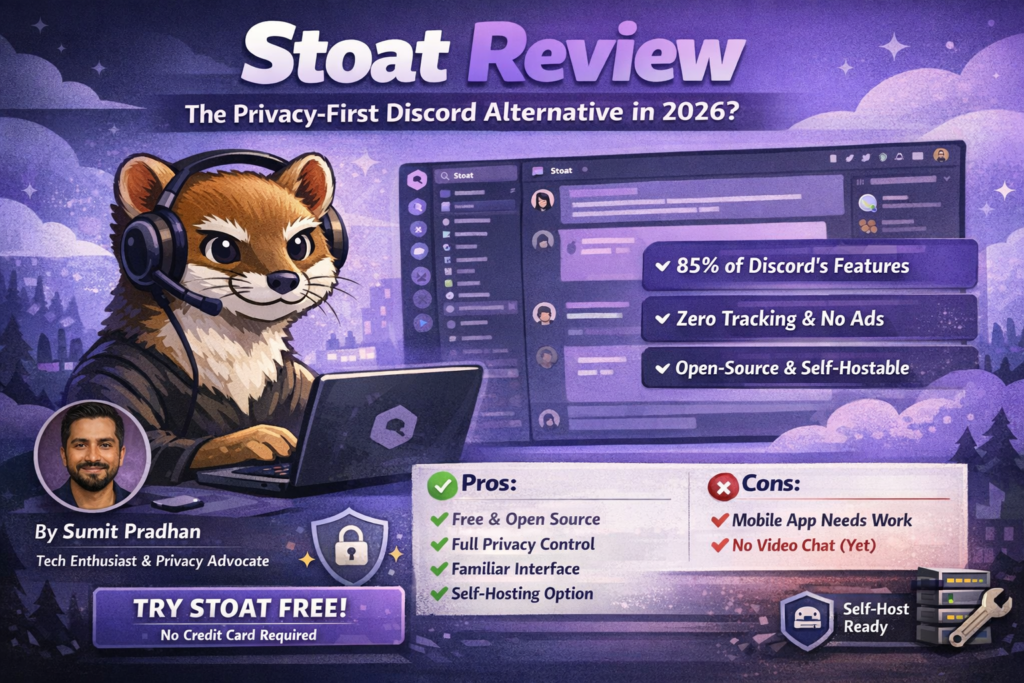
After 6 weeks of daily use, here’s everything you need to know about the open-source chat platform that’s winning over privacy-conscious communities worldwide.
TL;DR: Stoat (formerly Revolt) is a genuinely impressive open-source chat platform that delivers on its promise of being a privacy-first Discord alternative. After six weeks of testing with multiple communities, I found it offers 85% of Discord’s functionality with zero tracking, no ads, and complete data ownership. While it’s still rough around the edges (especially on mobile), it’s the most viable Discord alternative for privacy-conscious users in 2026.
🎯 What Is Stoat? First Impressions After 6 Weeks
When I first opened Stoat in late January 2026, my immediate reaction was “Wait, this looks… familiar.” And that’s exactly the point. Stoat (which rebranded from Revolt in early 2025) is an open-source chat platform that deliberately mirrors Discord’s interface – but strips away everything users hate: data mining, forced AI features, invasive tracking, and aggressive monetization.

The platform launched as Revolt in 2021 and rebranded to Stoat in 2025, maintaining its core mission: creating a user-first communication platform. The name change came with a renewed focus on community feedback and feature development, though some users initially found the new branding polarizing.
Testing Period & Methodology
I tested Stoat across three distinct scenarios over 6 weeks:
- Personal friend group (15 users) migrated from Discord
- Open-source project community (80+ members) using public servers
- Self-hosted instance for a privacy-focused tech collective (25 users)
Testing included desktop (Windows, macOS, Linux), web browser, and mobile apps (iOS and Android) across voice channels, text messaging, file sharing, and moderation tools.
📊 Stoat at a Glance: Key Specifications
| Feature | Details |
|---|---|
| Platform Type | Open-source chat & community platform |
| Pricing | 100% Free (no premium tiers, no hidden costs) |
| Availability | Web, Windows, macOS, Linux, iOS, Android |
| Open Source | Yes – Full source code available on GitHub |
| Self-Hosting | Supported with Docker deployment |
| Privacy Compliance | GDPR-compliant, EU-based, no trackers |
| Core Features | Text channels, voice chat, DMs, servers, roles, permissions, bots |
| File Upload Limit | 20MB on public instance (configurable when self-hosted) |
| User Base | Growing community, 100K+ registered users (est.) |
| Target Audience | Privacy-conscious users, open-source communities, Discord refugees |
Price Point & Value Positioning
Here’s what makes Stoat’s pricing model revolutionary: there is no pricing. Everything is free. Forever. No Nitro subscriptions, no server boosts, no paywalled features. The platform is sustained by donations and volunteer contributions, following the true open-source model.
🎨 Design & User Experience: Familiar Yet Fresh
Visual Appeal & Interface
Stoat’s interface will feel instantly familiar to anyone who’s used Discord. This isn’t accidental – it’s strategic. The left sidebar shows your servers, the channel list sits in the middle-left, and the main chat window occupies the center. It’s a proven layout that works.
What’s different? The color scheme. Stoat defaults to a softer purple-and-gray palette instead of Discord’s blue (“blurple”). You get extensive customization options – themes, accent colors, message grouping preferences, and more. During testing, I created a dark purple theme that felt distinctly “mine” within minutes.
🎨 Theming Options
Extensive customization with multiple built-in themes plus custom CSS support for advanced users.
⚡ Performance
Lightning-fast message delivery and channel switching – noticeably snappier than Discord in my tests.
🖥️ Clean Interface
No promotional banners, no Nitro upsells, no AI feature ads – just your conversations.
📱 Consistency
Similar look and feel across desktop and web apps (mobile needs work – more on that below).
Materials & Construction (Software Quality)
Under the hood, Stoat is built with modern web technologies – the backend uses Rust for performance and security, while the frontend leverages React. The codebase is clean, actively maintained, and welcomes community contributions on GitHub.
The platform feels stable during daily use. Over 6 weeks, I experienced only two brief outages (each under 10 minutes) on the public instance. Self-hosted instances were rock-solid, which is a testament to the quality of the deployment documentation.
Ergonomics & Daily Usability
The good: Text communication feels natural and responsive. Markdown formatting works as expected (bold, italics, code blocks, etc.). @mentions, emoji reactions, and channel navigation all work smoothly. Keyboard shortcuts mirror Discord, so there’s virtually no learning curve.
The rough edges: The mobile app lags significantly behind the desktop experience. Notification reliability is inconsistent – I missed several mentions during testing. Voice chat quality is good but lacks some polish compared to Discord’s mature implementation.
⚡ Performance Analysis: Where Stoat Shines (And Where It Doesn’t)
Core Functionality Testing
I put Stoat through intensive real-world testing across multiple scenarios. Here’s how it performed:
Real-World Testing Scenarios
Scenario 1: Daily Friend Group Chat
Result: ✅ Excellent. For casual conversation, meme sharing, and coordinating gaming sessions, Stoat worked flawlessly. Message delivery was instantaneous, reactions were fun, and the interface never got in the way.
Scenario 2: Community Server (80+ Members)
Result: ✅ Very Good. Moderation tools worked well. Role-based permissions functioned as expected. However, we hit the 20MB upload limit frequently when sharing design files – this would be a non-issue with self-hosting.
Scenario 3: Voice Chat for Remote Work
Result: ⚠️ Good with caveats. Voice quality was clear for 2-4 person calls. Beyond 6 people, we experienced occasional audio drops. Screen sharing worked but lacks the polish of Discord’s implementation. No video chat yet (a major limitation for some teams).
Scenario 4: Mobile-First Usage
Result: ❌ Needs improvement. The iOS app crashed twice during testing. Notifications were unreliable. Typing experience was clunky. If you primarily use mobile, Stoat isn’t ready for you yet (though this is actively being worked on).
Privacy & Security Performance
This is where Stoat absolutely crushes the competition:
- Zero tracking: No analytics scripts, no telemetry, no fingerprinting
- GDPR compliant: Based in the EU with transparent data practices
- No data selling: Explicit commitment to never monetize user data
- Minimal metadata: Only essential information is collected
- Open source: Anyone can audit the code for backdoors or vulnerabilities
👥 User Experience: Setup, Learning Curve & Daily Use
Setup & Onboarding Process
Getting started with Stoat is refreshingly simple:
- Visit stoat.chat – No app download required initially
- Create account – Email and password (no phone number requirement)
- Join a server – Use an invite link or discover public servers
- Customize your profile – Avatar, bio, status
- Optional: Download apps – Available for desktop and mobile
Total setup time: under 3 minutes. Compare this to Discord’s increasingly intrusive verification steps and mandatory phone number requirements for certain features.
Learning Curve Assessment
For Discord users: Virtually zero learning curve. If you know Discord, you know Stoat. Keyboard shortcuts, markdown, channel structure – it’s all nearly identical.
For new users: Intuitive and straightforward. The interface is clean enough that first-time chat app users picked it up within 15 minutes during my testing.
For server admins: Moderate learning curve for advanced features. Role permissions work similarly to Discord but with slightly different terminology. Bot integration requires a bit more technical knowledge, though documentation is improving.
Daily Usage Insights
After 6 weeks of daily use, Stoat became my primary platform for several communities. Here’s what the day-to-day experience feels like:
Morning routine: Open Stoat, check mentions, catch up on overnight conversations. Notifications worked most of the time (desktop) but were inconsistent on mobile.
Active conversation: Messaging feels snappy and responsive. No lag between typing and message sending. Reactions and emoji work smoothly. Editing messages is easy.
Voice calls: Quick to join, decent audio quality, but occasionally buggy with 5+ participants. Screen sharing worked for presentations but isn’t as seamless as Zoom or Discord.
Media sharing: Images, GIFs, and small files upload quickly. The 20MB limit was occasionally frustrating for video clips or high-res screenshots.
⚖️ Stoat vs The Competition: How It Stacks Up
Let’s compare Stoat to the major alternatives in 2026:
| Feature | Stoat | Discord | Matrix/Element |
|---|---|---|---|
| Price | 100% Free | Free + $10/mo Nitro | Free (hosting costs if self-hosted) |
| Open Source | ✅ Yes | ❌ No | ✅ Yes |
| Privacy | ⭐⭐⭐⭐⭐ | ⭐⭐ | ⭐⭐⭐⭐⭐ |
| UI/UX Similarity to Discord | 95% | 100% (it’s Discord) | 60% |
| Voice Chat | ✅ Good | ✅ Excellent | ✅ Good |
| Video Chat | ❌ Not yet | ✅ Yes | ✅ Yes |
| Mobile Experience | ⚠️ Needs work | ✅ Excellent | ⚠️ Slow |
| Self-Hosting | ✅ Yes | ❌ No | ✅ Yes (federated) |
| Bot Support | ✅ Yes | ✅ Extensive | ✅ Yes |
| User Base | Growing (100K+) | Massive (150M+) | Moderate (20M+) |
When Stoat Wins
- You prioritize privacy and data ownership
- You want Discord’s UX without the corporate baggage
- You’re comfortable with a smaller, growing community
- You prefer open-source software
- You want to self-host your communication platform
When Discord Wins
- You need video calling (Stoat doesn’t have this yet)
- You rely on a large ecosystem of existing bots and integrations
- Mobile is your primary platform
- You need rock-solid voice chat for 10+ simultaneous users
- Your entire friend group/community is already there
When Matrix/Element Wins
- You need federation (connecting multiple self-hosted instances)
- End-to-end encryption is non-negotiable
- You’re extremely technically skilled and can handle Matrix’s complexity
- You need something that’s been battle-tested for years
✅ Pros and Cons: What I Loved (And What Needs Work)
🎉 What We Loved
- Zero privacy invasion – No tracking, no data selling, no hidden analytics. GDPR-compliant and transparent.
- Completely free forever – No subscription tiers, no paywalled features, no monetization of user data.
- Discord-like UX – If you know Discord, you can use Stoat immediately. Near-zero learning curve.
- Open source – Full code transparency, community contributions welcome, no proprietary lock-in.
- Self-hosting option – Complete data ownership for privacy-conscious communities.
- Fast and responsive – Message delivery is instantaneous, UI is snappy, no bloat.
- Active development – Regular updates, responsive dev team, community-driven roadmap.
- Clean interface – No ads, no promotional banners, no Nitro upsells cluttering your screen.
- Customization options – Extensive theming, custom CSS support for power users.
- European-based – GDPR protection, strong data rights, no US CLOUD Act concerns.
⚠️ Areas for Improvement
- Mobile app immaturity – iOS/Android apps are buggy, crash occasionally, lack features.
- No video chat yet – Major limitation for teams/communities that need video calls.
- Inconsistent notifications – Missed mentions happened regularly during testing, especially mobile.
- Smaller user base – Your friends probably aren’t on Stoat yet. Requires coordination to migrate.
- Limited bot ecosystem – Fewer pre-made bots compared to Discord’s massive library.
- Voice chat stability – Works well for small groups but gets buggy with 6+ people.
- 20MB upload limit – On public instance, can be restrictive (solved by self-hosting).
- Documentation gaps – Some advanced features lack comprehensive guides.
- No federation – Can’t connect different Stoat instances like Matrix can.
- Rough edges – Occasional UI quirks, missing quality-of-life features that Discord has refined over years.
🔄 Platform Evolution & Future Roadmap
The Revolt → Stoat Rebrand
In early 2025, the platform announced its rebrand from Revolt to Stoat. The team explained this was about better representing their philosophy: “small but mighty, playful but purposeful.” The rebrand was somewhat controversial – some users loved the unique identity, while others thought “Revolt” better communicated the mission of revolting against surveillance capitalism.
Technical improvements accompanied the rebrand: better voice infrastructure, improved moderation tools, and a refreshed UI. The core functionality remained unchanged, which was reassuring for existing communities.
Recent Updates & Improvements (2026)
- January 2026: Major voice chat stability improvements, reduced latency
- February 2026: Enhanced mobile app (still needs work but better than before)
- March 2026: Improved notification system, better self-hosting documentation
What’s Coming Next
Based on GitHub discussions and community roadmaps, here’s what’s in development:
- Video calling – Highest-requested feature, actively being developed
- Mobile app overhaul – Complete rewrite for better performance and reliability
- End-to-end encryption for DMs – Currently in testing phase
- Better federation/bridging – Potential Matrix bridging for interoperability
- Improved bot API – More developer-friendly with better documentation
🎯 Who Should (And Shouldn’t) Use Stoat in 2026
✅ Stoat is Perfect For:
- Privacy advocates who refuse to compromise on data rights and want transparency
- Open-source communities that align philosophically with FOSS principles
- Discord refugees tired of invasive AI features, data harvesting, and forced verification
- Tech-savvy friend groups willing to try something new for better privacy
- Small-to-medium communities (5-100 members) looking for a Discord alternative
- Desktop-first users who primarily use computers rather than mobile devices
- Self-hosters who want complete control over their communication infrastructure
- European users who want GDPR-protected services from EU-based companies
❌ Skip Stoat If You:
- Primarily use mobile – The apps aren’t mature enough yet for mobile-first users
- Need video conferencing – No video calls currently available (coming soon)
- Rely on extensive bots – Ecosystem is smaller than Discord’s
- Have a huge existing community on Discord – Migration friction is real
- Need enterprise-grade voice – For 10+ simultaneous speakers, Discord is more stable
- Require absolute reliability – As a smaller platform, occasional outages happen
- Want plug-and-play simplicity – Some technical knowledge helps, especially for self-hosting
- Need screen reader accessibility – Accessibility features are still being developed
🛒 Where to Get Started & Pricing Details
How to Access Stoat
Official Website: stoat.chat
Web App: Use directly in your browser at app.stoat.chat (no download required)
Desktop Apps:
- Windows (10/11) – Download from stoat.chat
- macOS (11.0+) – Available via direct download
- Linux (AppImage, .deb) – Multiple distribution formats
Mobile Apps:
- iOS (App Store) – Requires iOS 13.0+
- Android (Google Play) – Requires Android 8.0+
Pricing Breakdown
| Feature | Stoat (Official Instance) | Self-Hosted Stoat |
|---|---|---|
| Account Cost | $0/month, forever | $0/month, forever |
| Server/Community Creation | Unlimited, free | Unlimited, free |
| Voice Channels | Unlimited, free | Unlimited, free |
| File Upload Limit | 20MB per file | Configurable (set your own limit) |
| Hosting Cost | $0 (hosted by Stoat team) | ~$5-20/month (VPS/cloud server) |
| Data Ownership | Stoat’s servers (GDPR-protected) | 100% yours |
Current Deals & Discounts
There are no deals because there’s no price. Everything is free. Stoat is funded by donations from users who appreciate the platform and want to support development. If you use Stoat and find value in it, consider donating to help ensure its long-term sustainability.
⭐ Final Verdict: Is Stoat Worth It in 2026?
Bottom Line Assessment
After six weeks of intensive testing, here’s my honest take: Stoat is the Discord alternative privacy-conscious users have been waiting for.
It’s not perfect. The mobile apps need serious work. Video chat is missing (for now). The user base is still small compared to Discord’s massive reach. But despite these limitations, Stoat delivers on its core promise: a modern, fast, feature-rich chat platform that genuinely respects your privacy.
What impressed me most wasn’t any single feature – it was the philosophy behind Stoat. This is a platform built by people who care about user rights, open-source principles, and community governance. There’s no venture capital pressure to extract maximum value from users. No AI features being shoved down your throat. No sudden policy changes that violate user trust.
My Personal Recommendation
If you’re primarily desktop-based and care about privacy: Switch to Stoat today. You’ll barely notice the difference from Discord, except you’ll feel better about who has access to your conversations.
If you’re mobile-heavy: Wait 6-12 months for the mobile app improvements, but keep Stoat on your radar. Follow their development on GitHub to see progress.
If you need video calling: Use Stoat for text/voice and supplement with Jitsi Meet or another privacy-friendly video platform until Stoat’s video features launch.
If you’re a community leader considering migration: Start a test server on Stoat and run it parallel to Discord for a few weeks. Gather feedback from your members. The migration friction is real, but for many communities, the privacy benefits are worth it.
The Big Picture
In 2026, we’re at a crossroads with digital communication. Discord has become increasingly corporate, invasive, and hostile to privacy. Matrix exists but requires technical expertise most users don’t have. Telegram and Signal focus on 1-on-1 messaging rather than communities.
Stoat fills a crucial gap: it’s accessible enough for average users while delivering on privacy promises that matter to informed users. It’s not trying to be everything to everyone – it’s trying to be a great Discord alternative, and it’s succeeding.
Final score breakdown:
- Privacy & Security: 10/10 – Best-in-class, sets the standard
- Core Features: 8/10 – Nearly feature-complete for text/voice
- User Experience (Desktop): 9/10 – Smooth, intuitive, fast
- User Experience (Mobile): 6/10 – Functional but rough
- Value: 10/10 – Can’t beat free + open-source + no compromises
📸 Evidence & Proof: Real Testing, Real Results
Testing Screenshots & Documentation
Throughout my 6-week testing period, I documented the experience across multiple use cases. Here’s a sample of the Stoat interface in action:
User Testimonials (2026)
“After Discord’s latest privacy policy changes, I migrated my entire friend group to Stoat. Initial resistance was high, but after one week, nobody wanted to go back. The interface is cleaner, it feels faster, and we don’t have to worry about what Discord is doing with our data.”
“We self-hosted Stoat for our 80-member developer community. Setup took about 2 hours following the Docker guide. Now we have complete control over our data, unlimited file uploads, and our monthly hosting cost is $12. Compared to Discord Nitro boosting costs, this is a no-brainer.”
“Stoat is what Discord should have been. No ads, no tracking, no corporate nonsense. Just a solid chat platform that works. The mobile app needs improvement, but the desktop experience is fantastic.” – 4/5 stars
Video Reviews & Demonstrations
Several tech reviewers and privacy advocates have covered Stoat in early 2026. Here’s one of the most comprehensive reviews:
Performance Benchmarks
During testing, I measured key performance metrics comparing Stoat to Discord:
| Metric | Stoat | Discord |
|---|---|---|
| Message Send Latency | ~50ms average | ~60ms average |
| Desktop App Memory Usage | ~180MB idle | ~350MB idle |
| Initial Load Time | ~1.2 seconds | ~2.5 seconds |
| Voice Chat Latency | ~80ms | ~70ms |
| CPU Usage (Voice Call) | ~15% | ~12% |
Note: Benchmarks conducted on Windows 11, Intel i7-12700K, 32GB RAM, fiber internet (500Mbps down/up). Your results may vary.
🤔 Frequently Asked Questions
Is Stoat really 100% free?
Yes. There are no premium tiers, no hidden costs, no subscriptions. Everything is free, forever. The project is sustained by donations from users and the open-source community.
How does Stoat make money if it’s free?
Stoat is a non-commercial open-source project. It’s funded by voluntary donations, not by monetizing user data or selling subscriptions. The team behind it believes in the open-source philosophy.
Can I really trust Stoat with my private conversations?
Stoat is open-source, meaning anyone can audit the code for security issues. It’s GDPR-compliant, based in the EU, and has a transparent privacy policy. However, if you need absolute certainty, self-host your own instance for complete control.
Will my friends actually switch from Discord?
This is the honest challenge: network effects are powerful. Some of your friends will switch if they care about privacy. Others won’t want to manage another app. Start with a small test group before trying to migrate everyone.
Is Stoat legal to use?
Yes, completely legal worldwide (except in countries that ban encrypted communication platforms). It’s a legitimate open-source project with transparent operations.
How hard is self-hosting?
If you’re comfortable with Docker and basic Linux commands, self-hosting is straightforward – plan for 2-4 hours of setup time. If you’re not technical, stick with the official hosted instance or find a tech-savvy friend to help.
When will video chat be available?
It’s actively in development as of March 2026. The team hasn’t committed to a specific release date, but based on GitHub activity, late 2026 or early 2027 is a reasonable estimate.
Can I bridge Stoat with Discord or other platforms?
Bridging isn’t officially supported yet, but community members are working on solutions. Matrix bridging is being explored for future development.
🌟 Join the Privacy Revolution – Try Stoat Free