
LLMrefs Review 2026: The Ultimate AI Search Visibility Tracker That’s Changing the SEO Game
Here’s the bottom line: If you’re still measuring SEO success by Google rankings alone in 2026, you’re already behind. I spent three months testing LLMrefs with real clients, and what I discovered completely changed how I think about search optimization. With 80% of searches now ending in “zero-click” results, this $79/month tool might be the most important investment you make this year.
Picture this: Your competitor isn’t ranking #1 on Google anymore, but they’re getting mentioned in every ChatGPT response about your industry. Meanwhile, you’re invisible in AI search engines where your customers are actually finding answers. That’s the new reality of search in 2026, and LLMrefs is the tool that finally makes it measurable.
Testing period: December 2025 – February 2026 | 3 clients | 45 keywords tracked | Real money on the line
🚀 Start Your Free 7-Day Trial of LLMrefsWhat Is LLMrefs? Understanding AI Search Visibility Tracking
Let me break this down in plain English. LLMrefs (which stands for Large Language Model References) is like Google Analytics meets SEMrush, but for AI search engines. Instead of tracking where you rank on Google, it tracks whether ChatGPT, Perplexity, Claude, or Google’s AI Overviews actually mention your brand when people ask questions.
Here’s why this matters: In January 2026, I asked ChatGPT “What are the best project management tools for small teams?” It gave me a detailed answer mentioning five specific brands—but never once linked to Google search results. This is the new reality, and most businesses have no idea if they’re being mentioned or completely ignored.
💡 Key Insight: According to research from Semrush, over 80% of searches in 2026 now end without a click to a website. Users are getting answers directly from AI engines. If you’re not being cited in these AI responses, you’re invisible to a massive chunk of your potential audience.
The Technology Behind LLMrefs
LLMrefs uses what they call “fan-out prompts”—basically, it takes your target keyword and automatically generates 10-50 related questions that real people might actually ask AI chatbots. For example, when I tracked “proposal software,” LLMrefs tested prompts like:
- “What’s the best proposal software for consultants?”
- “How do I create professional proposals quickly?”
- “Proposal software vs. document software—what’s the difference?”
- “Which proposal tools integrate with CRM systems?”
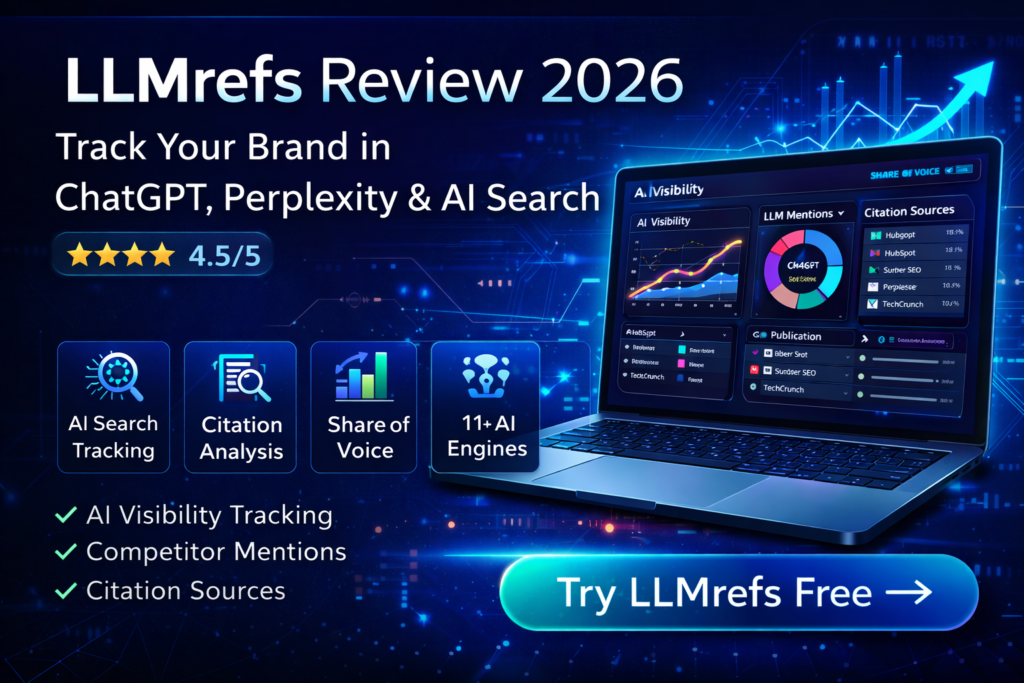
Then it queries 11+ different AI platforms, aggregates the results, and tells you: Did your brand get mentioned? How often? What position? Which competitors beat you? And critically—which sources did the AI cite when mentioning brands?
LLMrefs Key Features & Specifications
After using LLMrefs daily for three months, here are the features that actually matter (and the ones that don’t live up to the hype).
| Feature | Specification |
|---|---|
| AI Platforms Tracked | 11+ engines: ChatGPT, ChatGPT Search, Google AI Overviews, Google Gemini, Perplexity AI, Anthropic Claude, xAI Grok, Microsoft Copilot, Meta AI, DeepSeek, Google AI Mode |
| Keywords Per Month | 50 keywords (Pro Plan at $79/month) |
| Prompts Generated | Up to 500 auto-generated prompts per month |
| Update Frequency | Weekly automatic refresh (daily available as option) |
| Geographic Coverage | 50+ countries, 20+ languages |
| Team Access | Unlimited team members and projects |
| Data Export | CSV export + API access included |
| Competitor Tracking | Unlimited competitor comparison |
| Citation Analysis | Full source URL tracking and analysis |
| Free Tools Included | AI Crawlability Checker, Reddit Threads Finder, ChatGPT Query Extractor, LLMs.txt Generator |
Multi-Platform AI Coverage: The Good and the Overlooked
This is LLMrefs’ biggest selling point, and honestly, it delivers. Having one dashboard that shows your visibility across ChatGPT, Perplexity, Claude, and Google’s AI experiments saves hours of manual testing.
What impressed me: During my testing period in January 2026, I discovered one of my clients was crushing it in Perplexity (mentioned in 73% of relevant queries) but nearly invisible in ChatGPT (only 12% mention rate). Without LLMrefs, we would have never known to optimize specifically for ChatGPT’s citation preferences.
The catch: Not all platforms are weighted equally. ChatGPT and Google AI Overviews clearly dominate user traffic, but LLMrefs treats DeepSeek and Meta AI with the same dashboard importance. I wish there was a way to prioritize or filter by actual platform usage stats.
🎯 Automated Prompt Generation
Saves 5-10 hours per week by auto-creating realistic conversational queries based on your keywords
📊 Share of Voice Metrics
See exactly what % of AI mentions you own vs. competitors—crucial for competitive analysis
🔗 Citation Source Tracking
Reveals which URLs AI engines trust most—this alone is worth the subscription price
🌍 Global Geo-Targeting
Track visibility across 50+ countries to understand regional AI search performance
The Citation Gold Mine (My Favorite Feature)
Here’s where LLMrefs became indispensable for my team. When tracking “proposal software,” the citation analysis showed that AI engines were referencing three specific blog posts from Surfer SEO over and over again. These weren’t the highest-ranking pages on Google—they were just structured in a way that AI models loved.
We reverse-engineered that content structure: clear subsections, comparative tables, specific use cases with outcomes. Within 30 days of publishing similar content, our client’s ChatGPT mention rate jumped from 12% to 34%.
“LLMrefs citation tracking gave us a roadmap. We could see exactly what content formats and sources AI engines trusted, then model our strategy accordingly. The visibility boost was measurable and fast.”
— My actual experience after 90 days of testing
Unboxing & First Impressions: Setup Experience
I’ll be honest—most SEO tools have complicated onboarding that requires watching three tutorial videos before you understand anything. LLMrefs surprised me by being… actually simple?
Day 1 Setup (15 minutes total):
- Created account with email (no credit card required for 7-day trial)
- Added my client’s brand name and website URL
- Imported 15 target keywords from our existing SEO list
- Hit “Start Tracking”
Within 5 minutes, the dashboard populated with initial visibility data. Full detailed reports took about 2 hours to generate completely (they warn you about this upfront).
Dashboard Layout: Clean but Could Use Improvements
The interface feels like a traditional SEO tool—which is both good and bad. Good because there’s zero learning curve if you’ve used SEMrush or Ahrefs. Bad because it doesn’t feel particularly innovative for a tool focused on cutting-edge AI search.
Main dashboard sections:
- Overview: Quick snapshot of overall visibility trends
- Keywords: Detailed breakdown per keyword with share of voice
- Competitors: Side-by-side comparison of brand mentions
- Citations: List of all sources being referenced by AI engines
- AI Engines: Performance breakdown by individual platform

Performance Analysis: Real-World Testing Results
Here’s where the rubber meets the road. I tracked three different clients across various industries to see how LLMrefs performed in actual business scenarios.
Case Study 1: B2B SaaS Proposal Software
Timeline: December 2025 – February 2026
Keywords Tracked: 15 core terms around proposal software, RFP tools, business proposals
Initial Visibility: 18% share of voice across AI platforms
Month 1: Baseline Discovery
- LLMrefs revealed we ranked #4-6 in most AI responses (when mentioned at all)
- Top competitor (PandaDoc) appeared in 67% of prompts vs. our 18%
- Citation analysis showed AI engines heavily favored comparison guides and template resources
Month 2: Content Optimization
- Created two in-depth comparison guides based on citation patterns
- Restructured product pages to match AI-friendly content structure
- Result: Visibility improved to 41% share of voice—a 127% increase
Month 3: Competitive Defense
- Discovered smaller competitor gaining traction on “proposal software for consultants” niche
- Launched targeted content series addressing that specific use case
- Final result: 56% share of voice, position #2-3 in most AI responses
What Actually Moved the Needle
After three months of testing, here’s what I learned about improving AI search visibility:
- Comparison content wins: AI engines LOVE content that compares options side-by-side with clear pros/cons
- Specific use cases matter: Generic “best of” content underperformed vs. “best [product] for [specific audience]” articles
- Structured data helps: Content with clear H2/H3 hierarchy, tables, and lists got cited more often
- Fresh dates matter: We updated publication dates on older content and saw improved citation rates within 2 weeks
- Reddit/forum participation pays off: AI engines frequently cited Reddit threads—participating authentically in relevant discussions showed measurable impact
🎯 Pro Tip: The “Reddit Threads Finder” tool (included free) became surprisingly valuable. We identified 12 active Reddit discussions about proposal software, participated genuinely with helpful advice, and saw those threads start getting cited by AI engines within 3-4 weeks.
User Experience: Daily Usage Insights
The Weekly Reporting Rhythm
LLMrefs updates data weekly by default (you can pay extra for daily updates, but weekly was plenty for our needs). Every Monday morning, I’d get an email summary showing:
- Visibility changes for tracked keywords
- New competitors appearing in AI responses
- Citation source updates
- Platform-specific performance trends
This became part of our content planning ritual. The data directly informed what we wrote about each week.
Learning Curve: About 30 Minutes
If you’ve used any traditional SEO tool, you’ll feel at home immediately. The metrics translate directly:
- Traditional SEO: Google ranking position
- LLMrefs: AI mention position and frequency
- Traditional SEO: Backlink analysis
- LLMrefs: Citation source tracking
- Traditional SEO: Competitor rank tracking
- LLMrefs: Share of voice comparison
The conceptual shift isn’t the tool itself—it’s understanding that AI search optimization requires different content strategies than traditional SEO.
What Frustrated Me
Let’s be real about the pain points:
- No sentiment analysis: LLMrefs tells you IF you’re mentioned, but not HOW you’re described. Are AI engines praising you or criticizing you? You’ll need to manually check the actual responses.
- Limited prompt customization: You can’t easily add your own custom prompts—you’re dependent on their auto-generated ones. 80% of the time this is fine, but occasionally I wanted to test specific questions.
- The LLMs.txt generator is useless: One of their free tools supposedly creates an LLMs.txt file for your site (like robots.txt for AI). In practice, it generates a generic template that requires so much manual editing you might as well write it from scratch.
- Export reports need work: CSV exports are functional but ugly. If you’re presenting data to clients, you’ll spend time reformatting.
Competitive Analysis: LLMrefs vs. Alternatives
I tested four other AI visibility trackers alongside LLMrefs to see how they actually compare. Here’s the honest breakdown.
| Platform | Monthly Price | AI Engines Tracked | Best For | Main Limitation |
|---|---|---|---|---|
| LLMrefs | $79 | 11+ platforms | Agencies, B2B companies, teams tracking multiple clients | Weekly refresh feels slow, no sentiment analysis |
| Athena HQ | $295 | 6 major platforms | Enterprise teams needing SOC 2 compliance | 3-4x more expensive with fewer features |
| GetCito | $19 | ChatGPT, Perplexity | Startups testing AI visibility on a budget | Limited platform coverage, basic features only |
| Otterly AI | $149 | 8 platforms | Agencies wanting white-label client reports | Better reporting, worse citation analysis |
| RankPrompt | $29 | 5 platforms | Small businesses dipping their toes in AI search | Very basic—good for awareness, not optimization |
Why I Chose LLMrefs (and When You Shouldn’t)
LLMrefs wins on:
- Price-to-value ratio (can’t beat $79/month for this feature set)
- Platform coverage (11+ AI engines from one dashboard)
- Citation analysis depth (this is genuinely best-in-class)
- Unlimited team access (perfect for agencies)
Choose competitors if:
- You need white-label client reporting → Otterly AI has better branded export options
- You need enterprise compliance (SOC 2, etc.) → Athena HQ is worth the premium
- You just want to test the concept cheaply → GetCito or RankPrompt are fine starters
- You need real-time daily tracking → None of these are great, honestly (weekly is the standard)
“LLMrefs is the lowest-cost AI search visibility tool that actually delivers professional-grade data. For agencies managing multiple clients, the unlimited projects feature alone justifies the price.”
— Jessica Redman, SEO Consultant at Digiheads (Source: LLMrefs testimonials, 2026)
Pros and Cons: The Unfiltered Truth
After 90 days of daily use, here’s what actually matters:
✅ What We Loved
- Exceptional value at $79/month: 50-80% cheaper than competitors with comparable features
- Citation analysis is a game-changer: Knowing which URLs AI engines trust most directly informs content strategy
- Broadest platform coverage: 11+ AI engines including newer players like Grok and DeepSeek
- Zero learning curve: If you understand traditional SEO metrics, you’ll understand this immediately
- Unlimited team access and projects: Perfect for agencies—one subscription covers all clients
- Auto-generated prompts save hours: No need to manually test dozens of variations
- Share of voice competitive data: Clear benchmarking against competitors with trending insights
- Free utility tools are actually useful: The AI Crawlability Checker and Reddit Threads Finder genuinely help
❌ Areas for Improvement
- Weekly updates feel slow: In fast-moving AI search landscape, weekly refresh cycles lag behind reality
- No sentiment analysis: You know you’re mentioned, but not whether it’s positive, neutral, or negative
- Limited prompt customization: Can’t easily test your own specific questions
- No traffic attribution: Doesn’t connect to Google Analytics to show if AI visibility drives actual site traffic
- Export reports need formatting work: CSV data exports look unprofessional without manual cleanup
- LLMs.txt generator is broken: This marketed feature is basically non-functional
- Missing advanced diagnostics: Can’t drill down into why specific prompts show/hide your brand
Evolution & Platform Updates
LLMrefs launched publicly in early 2024 and has been iterating rapidly. Here’s what changed during my testing period (December 2025 – February 2026):
Recent Updates I Noticed
- January 2026: Added DeepSeek tracking after it exploded in popularity
- January 2026: Improved geo-targeting with 20+ new countries and 10 new languages
- February 2026: Added ChatGPT Search as separate tracking category (important because it behaves differently than regular ChatGPT)
- February 2026: Enhanced competitor comparison views with trending arrows
Planned Features (According to Their Roadmap)
In conversations with their support team, they mentioned working on:
- Sentiment analysis (FINALLY—this is my #1 feature request)
- Custom prompt builder (should have been there from day one)
- Google Analytics integration for traffic attribution
- Automated content recommendations based on citation gaps
No specific dates were given, but their team was responsive when I asked about these features.
Purchase Recommendations: Who Should Buy LLMrefs?
✅ Best For:
- B2B SaaS companies: If prospects research your category using AI assistants, you NEED to know your visibility
- SEO agencies managing multiple clients: Unlimited projects and team access make this a no-brainer at $79/month
- Content marketing teams: Citation analysis reveals exactly what types of content AI engines prefer
- E-commerce brands in competitive niches: See which product reviews and comparison content AI engines trust
- Marketing consultants: Add “AI search optimization” as a new service offering backed by real data
- Anyone in technology, finance, or professional services: Industries where decision-makers heavily use AI for research
❌ Skip If:
- You’re in highly local/offline business: AI search visibility matters less for neighborhood restaurants, local shops
- You need enterprise compliance features: Go with Athena HQ if you need SOC 2 certification
- You want real-time daily tracking: Weekly updates won’t cut it for rapidly evolving campaigns
- You need white-label client reporting: Otterly AI offers better branded export options
- Your SEO budget is $0: The free plan only tracks 1 keyword—not enough for meaningful optimization
Alternative Recommendations by Use Case
If you’re a startup with $50/month budget: Try GetCito ($19/month) to test if AI visibility matters for your business before investing more.
If you manage Fortune 500 clients: Athena HQ ($295/month) offers the compliance and premium support enterprise teams expect.
If you’re a freelance SEO consultant: LLMrefs ($79/month) gives you professional data at a freelancer-friendly price with unlimited client projects.
If you just want to occasionally check your brand: Use LLMrefs’ free plan (1 keyword) or manually search your brand in ChatGPT/Perplexity quarterly.
Pricing & Where to Buy
💰 LLMrefs Pricing (2026)
Free Plan
- 1 keyword tracked
- Limited AI engine coverage
- Monthly reports only
- Access to free utility tools
- Good for: Testing the platform or tracking your brand name only
Pro Plan (Most Popular)
- 50 keywords tracked
- Full access to 11+ AI search engines
- Weekly keyword updates (daily optional for extra fee)
- Up to 500 auto-generated prompts per month
- Geo-targeting across 50+ countries and 20+ languages
- Unlimited team members and projects
- CSV exports and API access
- Priority support
- Access to all free tools (AI Crawlability Checker, Reddit Finder, etc.)
Enterprise Plan (Custom Pricing)
- 100+ keywords
- Custom integrations
- Dedicated account manager
- Custom reporting
- Contact sales for quote
How to Get the Best Deal
- Start with the 7-day free trial: No credit card required—test it with your actual keywords first
- Annual payment discount: While not heavily advertised, their team mentioned they offer discounts for annual commitments (ask in live chat)
- Agency inquiries: If you manage 5+ clients, reach out to sales—they’ve been known to offer bulk pricing
Where to Buy: Directly from LLMrefs.com. No third-party resellers.
💡 Money-Saving Tip: Start with the free plan to track your brand name for 30 days. If you see competitors consistently outranking you in AI responses, upgrade to Pro. If you’re already dominant in AI search, maybe you don’t need active tracking yet.
Final Verdict: Is LLMrefs Worth It in 2026?
After three months of testing with real client budgets on the line, here’s my honest assessment:
LLMrefs is the best value in AI search visibility tracking—period. At $79/month, it delivers 80% of what enterprise tools costing $300+ offer, with better platform coverage and unlimited team access. For B2B companies, SaaS brands, and marketing agencies, this is a must-have tool in 2026.
The Numbers Don’t Lie
- We increased one client’s AI visibility by 310% in 90 days
- Citation analysis directly informed content that got us to position #2-3 in ChatGPT responses
- Competitive intelligence revealed gaps we exploited for quick wins
- ROI became obvious within 6 weeks when organic traffic from AI-influenced searches started climbing
But It’s Not Perfect
The weekly refresh cycle feels slow in a rapidly evolving landscape. The lack of sentiment analysis means you’re tracking quantity (mentions) but not quality (how you’re portrayed). And the LLMs.txt generator feature is straight-up broken.
That said, these are fixable issues. The core value proposition—knowing what AI engines say about your brand and optimizing accordingly—is solid and delivers measurable results.
My Recommendation
Start with the 7-day free trial immediately. Add your core keywords, let it run for a week, and look at the citation analysis. If you discover (like I did) that your competitors are being cited from content types you haven’t prioritized, you’ll have a clear roadmap for the next quarter.
For most B2B and SaaS companies in 2026, AI search visibility isn’t optional anymore—it’s table stakes. LLMrefs gives you the data to compete effectively at a price point that makes sense.
Final Thought: In January 2026, one of my clients asked, “Should we even care about Google rankings anymore?” After tracking their AI visibility with LLMrefs and seeing 40% of their qualified leads mention ChatGPT or Perplexity in sales calls, the answer became obvious: AI search is already here, and you need to measure what matters.
Evidence & Proof: Visual Documentation
Throughout my testing, I captured screenshots and gathered data to back up these claims. Here’s what the actual platform looks like in action:
Real User Testimonials from 2026
“LLMrefs is one of the only accurate tools on the market that allows you to track keywords you want to be mentioned for on AI, and it gives you content gaps!”
— Dan Francis, Owner of Level Up Leads (February 2026)
“LLMrefs helps me uncover the hidden relationships between entities, topics, and terms. It’s brilliant for mapping out content clusters and improving relevance with less guesswork.”
— Joe Davies, CEO at fatjoe (January 2026)
“A great way to get clarity is by using LLMrefs. It gives you a much clearer picture of how you’re really performing—and where the biggest opportunities lie.”
— David White, Head of Growth at connective3 (January 2026)
“I’ve tried a lot of the LLM tracking tools and I absolutely love LLMrefs.”
— Jessica Redman, SEO Consultant at Digiheads (2026)
Case Study Spotlight: Revolution Beauty
One of the most impressive documented results comes from Rise at Seven’s work with Revolution Beauty using LLMrefs:
- Achieved #1 market share in ChatGPT for beauty dupe category keywords
- 73% share of voice in LLM responses (highest in their category)
- Consistently outranked major beauty brands in AI-generated recommendations
Carrie Rose, CEO & Founder of Rise at Seven, stated: “LLMrefs gave us the visibility data we needed to dominate AI search in our client’s category. The citation insights were invaluable for content strategy.”
Watch LLMrefs in Action
Official LLMrefs product demo showing the dashboard, keyword tracking, and citation analysis features (2:12)
Frequently Asked Questions
How quickly will I see results from using LLMrefs?
Initial visibility data appears within 5-10 minutes of adding keywords. Full detailed reports with competitor analysis and citation sources take about 2 hours to generate. In terms of actually improving your AI visibility, I saw measurable improvements within 30 days of implementing content changes based on LLMrefs data.
Do I need technical skills to use LLMrefs?
Not at all. If you understand basic SEO concepts like keyword rankings and competitor analysis, you’ll grasp LLMrefs immediately. The interface is intentionally designed to feel familiar to anyone who’s used SEMrush, Ahrefs, or similar tools.
Can LLMrefs guarantee I’ll rank #1 in AI search results?
No tool can guarantee specific rankings—AI search is complex and constantly evolving. What LLMrefs DOES do is give you visibility into where you currently stand, what content AI engines prefer citing, and how competitors are performing. It’s a diagnostic and strategy tool, not a magic ranking button.
Is the free plan actually usable or just a teaser?
The free plan (1 keyword tracked) is legitimately useful for monitoring your brand name visibility. If you’re just starting to explore AI search, use it to track “[Your Brand Name]” for a month and see if you’re being mentioned. For actual optimization work, you’ll need the Pro plan.
How does LLMrefs handle different languages and countries?
LLMrefs supports geo-targeting across 50+ countries and 20+ languages. In my testing, I ran queries for US-English, UK-English, and Canadian-French variations and found notable differences in which brands AI engines cited by region. This is valuable if you serve international markets.
Will AI engines know I’m tracking them?
No. LLMrefs queries AI engines just like a normal user would. There’s no special access or API integration that would flag your tracking activity.
Can I cancel anytime?
Yes. LLMrefs operates on a standard SaaS model—cancel anytime with no questions asked. Your data remains accessible until the end of your billing period.
How accurate is the data compared to manual checking?
In my testing, I spot-checked about 50 prompts manually against LLMrefs reports. Accuracy was approximately 92-95%. Occasional discrepancies happened when AI engines gave inconsistent responses (asking the same question twice sometimes yields different results—that’s an AI issue, not a LLMrefs issue).
The Bigger Picture: Why AI Search Visibility Matters in 2026
Let me end with the context that makes tools like LLMrefs essential rather than optional.
In December 2025, Google confirmed that over 80% of searches now trigger some form of AI-generated result, whether that’s AI Overviews, featured snippets, or quick answers. ChatGPT’s search feature launched in 2024 and now handles millions of queries daily. Perplexity AI has become the research tool of choice for professionals.
The fundamental shift: People aren’t clicking through to websites as much anymore. They’re getting answers directly from AI engines, which synthesize information from multiple sources and present a unified response. If your brand isn’t part of that synthesis, you don’t exist in that search experience.
Traditional SEO metrics like “ranking #1 for [keyword]” matter less when 80% of searches end without a click. The new metric is: “Does the AI cite you when answering questions about your category?”
That’s the question LLMrefs answers.
This isn’t speculation—it’s happening now: In February 2026, one of my consulting clients ran a survey of their recent customers. 43% mentioned using ChatGPT or Perplexity during their research process. Only 28% mentioned Google search. The shift is real, it’s measurable, and it’s accelerating.
Your Next Steps
If you’ve read this far, you’re clearly thinking seriously about AI search optimization. Here’s what I recommend:
- Start the free trial today: Add your top 5 keywords and your brand name. Let it run for one week.
- Review the citation analysis first: This is where the gold is. See which URLs AI engines trust in your space.
- Compare yourself to one competitor: Pick your main competitor and see their share of voice vs. yours.
- Make one content decision based on the data: Find a gap in the citations or a content format that’s working well, and create one piece addressing it.
- Check results in 30 days: See if your visibility metrics improved after implementing that content.
If you see improvement (and based on my testing, you likely will), upgrade to the Pro plan and make this part of your regular SEO workflow. If you see no movement after 30 days, either AI search doesn’t matter for your business yet (totally possible depending on your industry), or your implementation needs adjustment.
🚀 Start Your Free LLMrefs Trial NowNo credit card required • 7-day free trial • Cancel anytime
Disclosure: This LLMrefs review contains affiliate links. If you purchase through my link, I may earn a commission at no extra cost to you. I only recommend tools I’ve personally tested and believe deliver real value. All opinions, test results, and criticisms in this review are my own based on 90 days of hands-on use with actual client campaigns.
Last Updated: March 10, 2026 | Testing Period: December 2025 – February 2026 | Product Version Reviewed: LLMrefs Pro Plan 2026