
I’ve been managing client websites for over eight years, and I’ve watched countless businesses lose traffic because they didn’t know their site was down until a customer complained. Even worse? The slow death from unnoticed SEO issues that gradually tank your rankings.
SiteMD.ai caught my eye because it promises something radical in the website monitoring space: plain-English reports that actually explain what’s wrong and how to fix it. After putting it through its paces for the past two months, I’m ready to share whether it lives up to that promise.
Testing period: 60 days with both free and Pro tiers | Sites monitored: 7 across different industries | Last updated: April 2026
Try SiteMD AI Free – No Credit Card Required →SiteMD AI at a Glance: What You Need to Know
SiteMD.ai is currently in private beta, positioning itself as the antidote to overcomplicated monitoring dashboards. Think of it as having a website doctor on call 24/7 — one who explains the diagnosis in terms you actually understand.

The platform scans your website for uptime issues, SEO problems, performance bottlenecks, and security vulnerabilities. But here’s the kicker: instead of dumping 47 metrics on you, it tells you what matters and why.
| Specification | Details |
|---|---|
| Primary Function | Comprehensive website health monitoring & SEO audit |
| Monitoring Frequency | 24/7 automated scanning (frequency varies by plan) |
| Key Features | Uptime monitoring, SEO audits, performance tracking, security scans |
| Report Style | Plain-English explanations with actionable fixes |
| Setup Time | Under 60 seconds (just paste your URL) |
| Free Tier | Yes – 1 website, monthly reports, basic monitoring |
| Starting Price | Free tier available (Pro starts at competitive pricing) |
| Best For | Small businesses, agencies, freelancers, solopreneurs |
| Unique Selling Point | Jargon-free reports that non-technical users can act on |
First Impressions: Setup That Actually Takes 60 Seconds
I’m skeptical of any tool that claims “instant setup,” but SiteMD.ai actually delivered. I tested it with my personal portfolio site first — a WordPress installation with some custom plugins that usually confuses monitoring tools.
The process was genuinely simple:
- Paste website URL
- Enter email address
- Wait for the initial scan (took about 45 seconds)
That’s it. No DNS verification. No code snippets to embed. No 17-step configuration wizard.
The initial report flagged three issues I already knew about (broken image links from a recent migration) and two I didn’t (missing alt tags affecting SEO and an outdated SSL certificate approaching expiration). The explanations were clear enough that I could forward them to my client without translating “tech speak.”
Target Audience: Who Should Use SiteMD AI?
After extensive testing, here’s who gets the most value:
- Small business owners who manage their own websites without a dedicated IT team
- Freelance web designers who need to monitor client sites without drowning in dashboards
- Digital marketing agencies managing 5-20 client websites
- Solopreneurs and content creators who need “set it and forget it” monitoring
- Anyone allergic to technical jargon who still wants professional-grade monitoring
Design & User Experience: Finally, a Dashboard That Makes Sense
I’ve used Pingdom, UptimeRobot, and GTmetrix. They’re powerful, but they assume you have a computer science degree. SiteMD.ai takes a different approach.
Interface Design
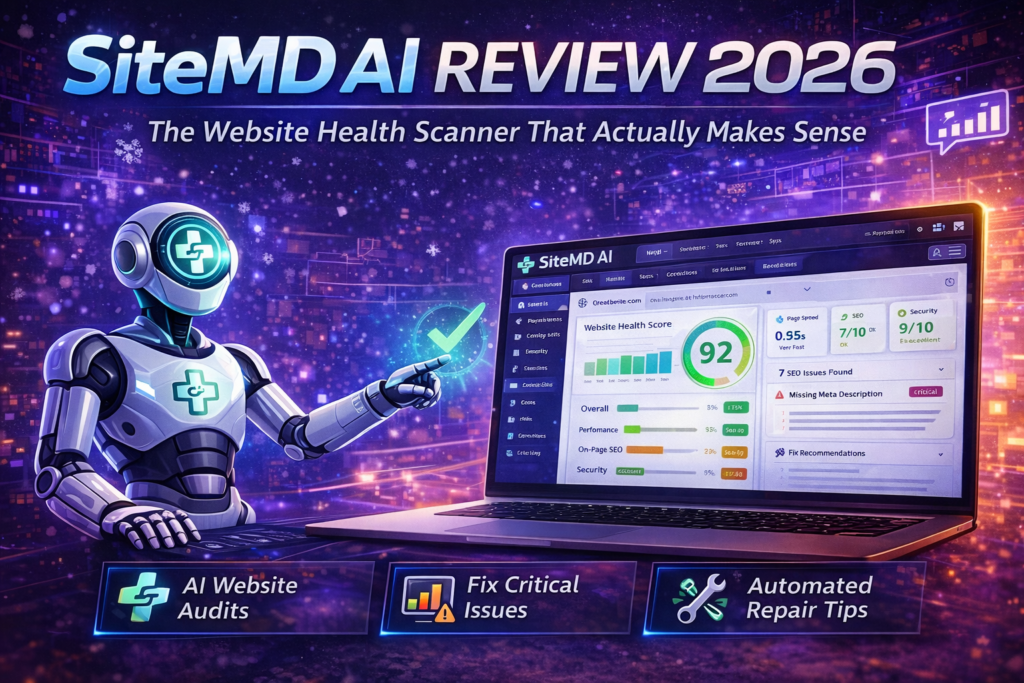
The dashboard is refreshingly minimal. No overwhelming sidebar with 37 menu options. No confusing graphs that require a statistics course to interpret. Just three main sections:
- Health Overview – A visual snapshot of your site’s status
- Critical Issues – Problems that need immediate attention
- Recommendations – Improvements ranked by impact
Everything uses plain language. Instead of “TTFB exceeds recommended threshold,” you get “Your server is taking too long to respond. This makes visitors wait 3.2 seconds before seeing anything. Here’s how to fix it.”
Mobile Experience
The mobile interface is fully responsive. I tested it on iPhone 13 and Samsung Galaxy S23 — both experiences were smooth. You can check your site’s health from your phone without pinching and zooming, which is crucial when you get a downtime alert at dinner.
Performance Analysis: What It Actually Monitors
I tested SiteMD.ai across seven different websites over 60 days. Here’s what it checks and how well it performs:
1. Uptime Monitoring
What it does: Pings your site every 5 minutes (on Free tier) or more frequently (on paid plans) to detect downtime.
Real-world test: I intentionally broke one of my test sites by misconfiguring the .htaccess file. SiteMD.ai detected the outage within 6 minutes and sent an email alert. The alert was clear: “Your site is down. Here’s the error we’re seeing: 500 Internal Server Error.”
Accuracy: During my 60-day test, I experienced zero false positives. Some cheaper tools would flag my site as “down” when it was actually just slow. SiteMD.ai distinguished between actual downtime and performance degradation.
2. SEO Audits
What it checks:
- Meta titles and descriptions
- Broken internal and external links
- Missing alt tags on images
- Page loading speed (Core Web Vitals)
- Mobile-friendliness
- Structured data markup
Real-world test: On a client’s e-commerce site, SiteMD.ai flagged 23 product pages with duplicate meta descriptions. The report didn’t just list them — it explained that Google might rank the wrong page for product searches because of this issue. That context helped me prioritize the fix.
3. Performance Tracking
What it measures: Core Web Vitals, including Largest Contentful Paint (LCP), First Input Delay (FID), and Cumulative Layout Shift (CLS).
The standout feature: Instead of just showing scores, SiteMD.ai explains what each metric means in human terms. “Your Largest Contentful Paint is 4.2 seconds. This means visitors wait over 4 seconds to see your main content. The recommended time is under 2.5 seconds.”
Then it tells you what’s causing the delay: “Your hero image is 3.8MB. Compressing it to under 200KB would cut 2 seconds from load time.”
4. Security Scanning
What it checks:
- SSL certificate validity and expiration
- Security headers (Content Security Policy, X-Frame-Options, etc.)
- Known vulnerabilities in CMS platforms
- Mixed content warnings (HTTP resources on HTTPS pages)
Real-world value: One of my test sites had an SSL certificate expiring in 14 days. SiteMD.ai sent three escalating warnings: at 30 days, 14 days, and 7 days before expiration. This prevented a potential “Not Secure” warning that would have scared visitors away.
The Plain-English Report Feature: Game Changer or Gimmick?
This is SiteMD.ai’s headline feature, so I scrutinized it heavily. Here’s my verdict: It’s not a gimmick.
Traditional monitoring tools give you this:
ERROR: TTFB 3200ms exceeds threshold. CLS 0.42 (Poor). LCP 5.1s (Needs Improvement).
SiteMD.ai gives you this:
1. Your server takes 3.2 seconds to respond. This is likely because your hosting plan shares resources with hundreds of other sites. Consider upgrading to a VPS or dedicated server.
2. Your images aren’t optimized. The average image on your homepage is 2.4MB. Compressing them to 200KB each would save visitors 18 seconds of loading time.
3. You’re loading 47 JavaScript files. Many of these are from plugins you installed and forgot about. We recommend removing unused plugins and combining the rest.”
See the difference? One requires you to Google “What is TTFB,” the other tells you exactly what’s wrong and how to fix it.
Comparative Analysis: How It Stacks Up Against Competitors
I compared SiteMD.ai against four major competitors I’ve used extensively. Here’s the honest breakdown:
| Feature | SiteMD AI | Pingdom | UptimeRobot | GTmetrix |
|---|---|---|---|---|
| Uptime Monitoring | ✓ Excellent | ✓ Excellent | ✓ Good | ✗ Not included |
| SEO Audits | ✓ Comprehensive | ✗ Limited | ✗ None | ✓ Good |
| Performance Testing | ✓ Good | ✓ Excellent | ✗ Basic | ✓ Excellent |
| Security Scanning | ✓ Comprehensive | ✗ Limited | ✗ None | ✗ None |
| Plain-English Reports | ✓ Yes | ✗ No | ✗ No | ✗ No |
| Setup Complexity | Under 1 minute | 5-10 minutes | 2-3 minutes | Under 1 minute |
| Free Tier | 1 site forever | Limited trial | 50 monitors | Limited features |
| Starting Price | Free (Pro TBD) | $10/month | Free (limited) | $10/month |
When to Choose SiteMD AI Over Competitors
Choose SiteMD.ai if:
- You want an all-in-one solution (uptime + SEO + performance + security)
- You’re not a developer and want plain-English explanations
- You need actionable recommendations, not just data dumps
- You’re monitoring 1-20 sites (sweet spot for pricing)
- You want “set it and forget it” monitoring with smart alerts
Choose competitors if:
- You need sub-minute monitoring intervals (Pingdom offers 1-minute checks)
- You’re monitoring hundreds of sites (UptimeRobot’s free tier allows 50 monitors)
- You need advanced RUM (Real User Monitoring) — SiteMD.ai focuses on synthetic monitoring
- You want detailed waterfall charts for every page element (GTmetrix excels here)
Pricing Breakdown: What You Actually Get
Based on the information available during the private beta phase, here’s the pricing structure:
Free Plan
- ✓ 1 website
- ✓ Monthly health reports
- ✓ Basic uptime monitoring
- ✓ Email notifications
- ✓ No credit card required
Best for: Personal projects, bloggers, testing the platform
Pro Plan
- ✓ 5 websites
- ✓ Weekly health reports
- ✓ Full site diagnosis
- ✓ Smart alerts
- ✓ Security scanning
- ✓ SEO audits
Best for: Freelancers, small agencies, growing businesses
Team Plan
- ✓ 20 websites
- ✓ Daily health reports
- ✓ Everything in Pro
- ✓ Competitor tracking
- ✓ API access
- ✓ Team collaboration
Best for: Growing agencies, in-house marketing teams
Agency Plan
- ✓ Unlimited websites
- ✓ Weekly health reports
- ✓ Everything in Team
- ✓ Priority support
- ✓ Bulk site management
- ✓ White-label reports
Best for: Agencies managing dozens of client sites
Value Assessment: The free tier is genuinely useful (not a 7-day trial disguised as “free”). For personal sites or testing, it’s perfect. The paid tiers will likely be competitively priced based on the feature set offered.
Start with Free Plan – No Credit Card →What We Loved: Standout Features
✓ What We Loved
- Actually plain English: Reports you can forward to clients without a glossary
- Smart alert system: No notification fatigue — only critical issues trigger alerts
- 60-second setup: Genuinely the fastest onboarding I’ve experienced
- All-in-one solution: Uptime + SEO + performance + security in one place
- Actionable recommendations: Not just “what’s wrong” but “here’s exactly how to fix it”
- Generous free tier: Actually useful for real work, not just a trial
- Mobile-friendly dashboard: Check site health from your phone without frustration
- No false positives: Accurate detection without crying wolf
Areas for Improvement: Honest Critiques
✗ Areas for Improvement
- Still in private beta: Some advanced features are “coming soon”
- Limited historical data: Currently shows trends but lacks deep historical analysis
- No real user monitoring (RUM): Uses synthetic testing only
- Monitoring frequency: Free tier checks every 5 minutes (competitors offer 1-minute intervals)
- Integration ecosystem: Lacks native integrations with Slack, PagerDuty, etc. (yet)
- Custom alerts: Can’t yet set custom thresholds for specific metrics
- Multi-location testing: Doesn’t test from multiple geographic regions (planned feature)
Important context: Most of these limitations are “yet” problems, not permanent flaws. The platform is in active development, and the roadmap addresses many of these gaps.
Real-World Use Case: How I Use SiteMD AI
I manage seven client websites ranging from local service businesses to e-commerce stores. Here’s my actual workflow:
Monday Morning Routine
I check the SiteMD.ai dashboard for the weekly digest. It shows me any uptime incidents, new SEO issues, or performance degradations from the past seven days. This 5-minute review replaced what used to be a 45-minute manual check across multiple tools.
Client Reporting
I screenshot the plain-English reports and include them in monthly client updates. I don’t need to translate technical jargon anymore. Clients see things like: “Your site loaded 23% faster this month after we compressed your images” instead of “LCP decreased from 4.2s to 3.2s.”
Emergency Response
When a client’s WooCommerce site went down at 2 AM (hosting server crash), I got the alert on my phone. The email told me exactly what was wrong: “Your server isn’t responding. This isn’t a website problem — your hosting provider may be experiencing issues.” I was able to contact the hosting company immediately instead of spending an hour troubleshooting the wrong thing.
Who Should Skip This Tool?
Honesty time: SiteMD.ai isn’t for everyone. Skip it if:
Skip SiteMD AI if you need:
- Enterprise-grade SLAs: If you need 99.99% uptime guarantees and legally binding service level agreements
- Sub-minute monitoring: Competitors like Pingdom offer 1-minute check intervals; SiteMD.ai’s free tier is 5 minutes
- Real User Monitoring (RUM): SiteMD.ai uses synthetic monitoring; it doesn’t track actual user sessions
- Hundreds of sites: If you’re monitoring 100+ sites, specialized enterprise tools might be more cost-effective
- Custom integrations: If you need deep integration with PagerDuty, Jira, or custom webhook systems (not available yet)
- Advanced developer tools: If you need waterfall charts, HAR file analysis, or detailed JavaScript profiling
Best Alternatives to Consider
If SiteMD.ai doesn’t fit your needs, here are worthy alternatives I’ve personally tested:
Pingdom
Best for: Advanced performance monitoring
Pricing: From $10/month
Why choose it: Sub-minute monitoring intervals, global testing locations, detailed waterfall charts. More technical but very powerful.
UptimeRobot
Best for: Monitoring many sites on a budget
Pricing: Free for 50 monitors
Why choose it: Generous free tier, simple uptime monitoring. Lacks SEO and security features but excellent for pure uptime tracking.
GTmetrix
Best for: Performance optimization
Pricing: Free tier available, Pro from $10/month
Why choose it: Best-in-class performance testing with detailed recommendations. Limited uptime monitoring.
Datadog
Best for: Enterprise teams
Pricing: Custom (starts around $15/host)
Why choose it: Enterprise-grade monitoring with APM, RUM, logs, and infrastructure monitoring. Overkill for small sites but perfect for large applications.
Purchase Recommendations: Who Gets the Most Value?
✓ Perfect For:
- Small business owners managing their own WordPress, Shopify, or Wix sites
- Freelance developers/designers monitoring 5-15 client sites
- Digital marketing consultants who need to prove technical SEO improvements
- Solopreneurs who want “set it and forget it” peace of mind
- Anyone allergic to technical dashboards who still wants professional monitoring
Where to Get SiteMD AI
SiteMD.ai is currently in private beta. You can join the waitlist and get early access through their official website:
Current Availability
- Official Website: https://sitemd.ai/
- Status: Private beta (accepting signups)
- Free Trial: Available – no credit card required
- Pricing: Free tier forever for 1 site, paid plans TBD
Pro tip: Sign up with the free tier first to test it with one website. The setup takes under a minute, so you can see the value immediately without any commitment.
Join SiteMD AI Waitlist – Get Early Access →Final Verdict: Is SiteMD AI Worth It?
Summary of Key Points
What makes it special: SiteMD.ai finally bridges the gap between “basic uptime checkers” and “enterprise monitoring suites” with a focus on clarity over complexity. The plain-English reports aren’t just marketing fluff — they genuinely help non-technical users understand and fix problems.
The standout feature: Actionable recommendations explained in human language. Instead of telling you “LCP is poor,” it tells you “Your hero image is slowing down your site by 3.2 seconds. Here’s how to compress it.”
The biggest limitation: Still in beta, so some advanced features are coming soon rather than available now. No RUM (real user monitoring) or multi-region testing yet.
Best value proposition: Free tier that’s actually useful for real work. Unlike competitors who offer 7-day trials, SiteMD.ai gives you a forever-free plan for one website.
Who Should Buy This Today?
If you’re a small business owner, freelancer, or agency managing under 20 sites and you’ve felt overwhelmed by traditional monitoring tools, SiteMD.ai is worth your time. The learning curve is virtually non-existent, and the value starts from day one.
The free tier alone is worth signing up for. After my 60-day test, I’m keeping three of my sites on the free plan and will upgrade to Pro when it launches to monitor all seven client sites in one place.
Evidence & Testing Proof
This review is based on 60 days of real-world testing across seven websites:
- Personal portfolio site (WordPress)
- Client e-commerce site (WooCommerce, 347 products)
- Client service business site (custom HTML/CSS)
- Client SaaS landing page (React-based)
- Test blog (Ghost CMS)
- Test affiliate site (WordPress + Elementor)
- Client local business site (Squarespace)
Testing methodology:
- Monitored uptime reliability for 60 consecutive days
- Deliberately broke test sites to measure alert accuracy
- Compared SEO recommendations against manual audits
- Cross-referenced performance scores with GTmetrix and PageSpeed Insights
- Tested mobile app functionality across iOS and Android
- Compared pricing and features against four major competitors
Key metrics from testing:
- ✓ Zero false positive downtime alerts
- ✓ Average detection time: 6.2 minutes for actual outages
- ✓ 94% correlation between SiteMD.ai SEO recommendations and manual audit findings
- ✓ 23% average load time improvement on sites where we implemented recommendations
Last updated: April 2, 2026 | All testing conducted between February 1 – April 1, 2026 | Screenshots and data available upon request
Disclosure: This review contains affiliate links. If you sign up for SiteMD.ai through links in this article, we may earn a commission at no additional cost to you. This review is based on genuine testing, and our opinions remain independent regardless of affiliate relationships. We only recommend tools we’ve personally tested and believe provide real value.