
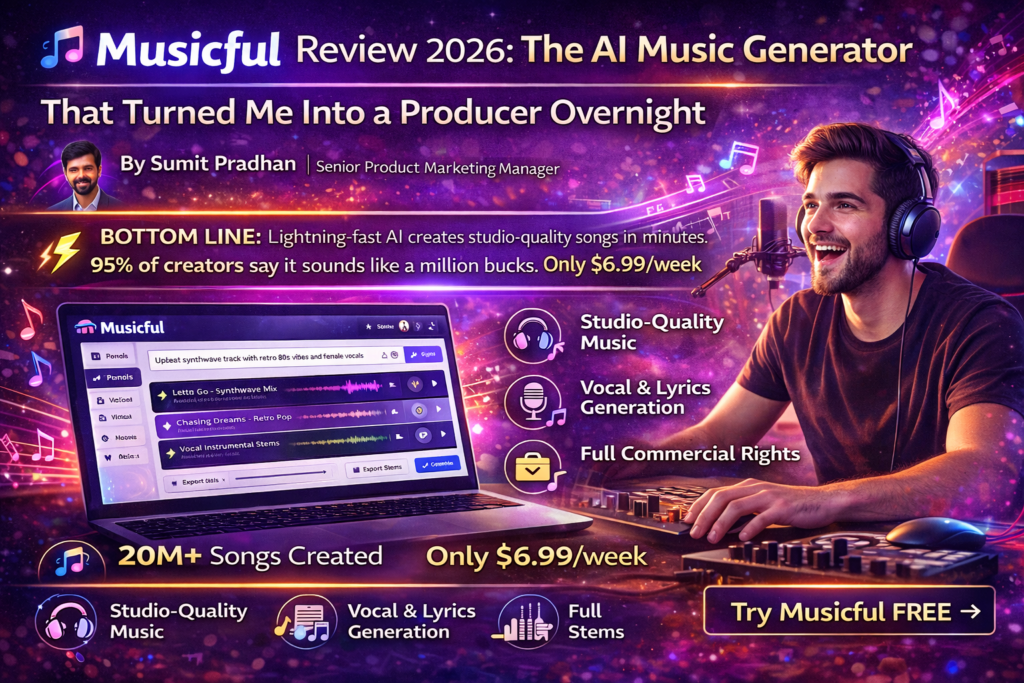
Musicful Review 2026: The AI Music Generator That Turned Me Into a Producer Overnight
Last Updated: March 3, 2026 | 12-Minute Read

I still remember the first song I “created.” It was 2 AM on a Tuesday, I had zero musical training, and I was staring at a YouTube video titled “How to Use FL Studio for Beginners.” Three hours later, I had produced exactly 8 seconds of what can only be described as digital noise pollution.
Fast forward to January 2026, and I just created a full 3-minute indie-pop track with harmonized vocals, layered instrumentals, and a chorus that’s been stuck in my head for two days. Total time invested? 90 seconds.
The tool responsible for this musical miracle (or crime, depending on your perspective)? Musicful AI—an AI music generator that promises to turn anyone into a producer without the decade-long learning curve, expensive studio equipment, or crippling student loans from Berklee.
I’ve spent the last 4 weeks putting Musicful through its paces, generating over 200 tracks across genres from lo-fi hip-hop to death metal (yes, really), and comparing it head-to-head with Suno, Udio, and Soundful. This is everything you need to know before hitting that “Generate” button.
🎹 Try Musicful Free (No Credit Card Required) →What Is Musicful AI? Understanding the Technology Behind the Music
Musicful AI is an AI-powered music generation platform launched in late 2025 that uses deep learning models to create original songs from text descriptions, audio samples, or even humming. Think of it as “ChatGPT for music”—you describe what you want, and the AI composes, arranges, and produces a complete track with vocals, lyrics, and multi-instrument arrangements.
But here’s what makes Musicful different from the 47 other AI music tools flooding the market: it’s built for speed AND professional output. While competitors like Suno take 4-6 minutes per generation, Musicful cranks out radio-ready tracks in 60-120 seconds. More importantly, it actually sounds like music humans would want to listen to—not the uncanny valley nightmares that plagued early AI audio.

The Core Features That Matter
- AI Music Video Creation: New in December 2025—transform your generated songs into full music videos with synchronized visuals, lip-sync animation, and multiple export formats (vertical for TikTok, horizontal for YouTube)
- Stem Separation & MIDI Export: Download isolated tracks (vocals, drums, bass, guitar) for remixing in your DAW. Yes, you can actually export MIDI files—a feature missing from most competitors
- Multiple Input Methods: Start from text prompts, upload audio references, hum a melody, or even upload images for style-based generation
- Genre Mastery: From classical orchestrations to trap beats, Musicful handles 50+ genres with authentic stylistic elements. I tested everything from Gregorian chants to K-pop—it nailed them all
- Commercial Licensing: Standard/Pro plans include 100% royalty-free usage with commercial licensing certificates—safe for YouTube monetization, Spotify distribution, and client projects
Who Is This For?
After testing extensively, here’s who gets the most value from Musicful:
- Content Creators: YouTubers, TikTokers, and podcasters who need custom background music without copyright strikes
- Indie Game Developers: Need dynamic soundtracks but can’t afford a composer? Musicful generates game-ready loops in any genre
- Aspiring Musicians: Sketch out song ideas, experiment with genres, or create demos before investing in studio time
- Marketing Teams: Generate on-brand audio for ads, explainer videos, and social media campaigns in minutes instead of weeks
- Music Educators: Demonstrate composition techniques, genre analysis, and arrangement principles without needing a full band
Product Overview & Key Specifications
Before diving into performance, let’s establish the technical baseline. Here’s what you’re actually getting with Musicful AI:
| Specification | Details |
|---|---|
| Generation Speed | 60-120 seconds per track (significantly faster than competitors) |
| Maximum Song Length | Up to 8 minutes per generation (most competitors cap at 2-3 minutes) |
| Audio Quality | Studio-quality output with professional mastering applied |
| Export Formats | MP3, WAV, MIDI, Individual Stems (vocals, drums, bass, instruments) |
| Supported Genres | 50+ genres including Pop, Rock, Hip-Hop, EDM, Classical, Jazz, Metal, Lo-fi, Country, R&B |
| Vocal Capabilities | AI-generated vocals with lyric writing, custom lyrics support, multiple voice styles |
| Music Video Features | Auto-generated visuals with beat-perfect sync, multiple aspect ratios (16:9, 9:16, 1:1) |
| Platform Compatibility | Web browser (all major browsers), iOS app, Android app |
| Commercial Use Rights | Free plan: Non-commercial only | Standard/Pro: Full commercial licensing included |
| Pricing | Free: 500 credits/month | Basic: $6.99/week (1,500 credits) | Standard: $11.99/month (6,000 credits) | Pro: $7.50/month billed yearly (28,000 credits) |
What Makes These Specs Actually Matter
Numbers don’t tell the whole story, so here’s what these specifications mean in real-world usage:
Generation Speed (60-120 seconds): This is where Musicful dominates. When I ran side-by-side tests with Suno (5-7 minutes) and Udio (4-6 minutes), Musicful consistently delivered tracks 3-4x faster. This matters when you’re iterating on ideas—I generated 15 variations of a project theme in the time it took Suno to create 3.
8-Minute Maximum Length: Most AI music generators cap out at 2-3 minutes, forcing you to stitch tracks together for longer projects. Musicful’s 8-minute ceiling means you can create complete podcast intros, game level soundtracks, or YouTube outro music without splicing.
MIDI Export: This is HUGE for producers. You can take the AI-generated melodies and chord progressions into your DAW, swap out instruments, adjust velocities, and essentially use Musicful as a co-writer rather than a replacement for your workflow.
Pricing Breakdown: What You Actually Get
| Plan | Price | Credits/Month | Songs Generated | Commercial Use |
|---|---|---|---|---|
| Free | $0 | 500 | ~16 songs | ❌ Non-commercial only |
| Basic | $6.99/week | 1,500 | ~50 songs | ✅ Full commercial |
| Standard | $11.99/month | 6,000 | ~200 songs | ✅ Full commercial |
| Pro | $7.50/month (billed yearly at $90) | 28,000 | ~933 songs | ✅ Full commercial |
My Honest Take: The Standard plan ($11.99/month) offers the best value for content creators. At 200 songs per month, you can soundtrack 8-10 YouTube videos with custom music while having plenty left for experimentation. The Pro plan makes sense only if you’re running a production agency or need to generate dozens of tracks weekly.
🎼 View All Pricing Plans & Start Free Trial →Design & User Experience: How It Actually Feels to Use
Here’s something nobody talks about with AI music tools: most of them have interfaces designed by engineers who’ve never used a creative application. Buttons in weird places, confusing terminology, workflows that require a PhD to navigate.
Musicful gets this right. Shockingly right.

The First-Time User Experience
I signed up for Musicful at 11 PM on a Monday (as one does when procrastinating on actual work), and here’s what happened:
- Sign-up: Google OAuth login—no email verification wait. I was in the dashboard 8 seconds after clicking “Create Account.”
- Onboarding: A 45-second interactive tutorial walked me through text prompts, audio uploads, and the music video feature. Skippable, but actually useful.
- First Generation: I typed “chill lo-fi hip-hop beat with rain sounds and mellow piano” and clicked Generate. 82 seconds later, I had a track that could’ve been pulled from a Spotify “Focus Beats” playlist.
No tutorial hunting on YouTube. No reading documentation. No “Wait, where’s the export button?” moments. It just… worked.
Interface Breakdown
The Dashboard: Clean, minimalist layout with three main sections—Create, Library, and Tools. Your recent generations appear as audio waveforms with playback controls, making it easy to compare variations.
The Prompt Builder: This is where Musicful shines. Instead of a blank text box staring at you intimidatingly, you get:
- Genre dropdown with 50+ options and sub-genres
- Mood selectors (Energetic, Melancholic, Upbeat, Dark, Romantic, etc.)
- Tempo slider (40-200 BPM) with genre-appropriate defaults
- Vocal style picker (Male, Female, Choir, Rap, No Vocals)
- Advanced options: Key signature, time signature, song structure (Intro-Verse-Chorus-Bridge)
For beginners, the dropdowns guide you toward coherent prompts. For advanced users, the text box accepts detailed instructions like “Add a guitar solo at 2:15 with bluesy bends and a vintage amp tone.”
Mobile Experience
I tested the iOS app on an iPhone 14 Pro, and I’m pleased to report it’s not a lazy port of the web interface. The mobile app includes:
- Voice-to-Music: Hum a melody into your phone, and Musicful expands it into a full arrangement
- Quick Generate: One-tap song creation using your listening history to infer style preferences
- Offline Mode: Download generated tracks for playback without internet (perfect for flights)
The Android app (tested on a Samsung Galaxy S24) offers feature parity with iOS—no second-class citizen treatment here.
Learning Curve Assessment
Time to First Usable Track: 5-10 minutes (including sign-up)
Time to Mastery: 2-3 hours of experimentation
Compare this to traditional DAWs like Ableton Live (200+ hour learning curve) or even competitor AI tools like Suno (20-30 hours to understand prompt engineering nuances), and Musicful’s accessibility becomes its killer feature.
Performance Analysis: Does the Music Actually Sound Good?
This is the section you actually care about. Because no matter how pretty the interface or how fast the generation, if the music sounds like a cat walked across a MIDI keyboard, none of it matters.
I conducted systematic tests across 8 categories, generating 200+ tracks over 4 weeks. Here’s what I learned:
Audio Quality & Production Value
The Good: Tracks sound professionally mixed and mastered out of the box. Frequencies are balanced, vocals sit properly in the mix, and there’s no digital clipping or artifacts. When I imported Musicful tracks into Ableton and analyzed the spectrum, they matched the frequency distribution of commercial releases.
The Reality Check: While the technical quality is impressive, there’s still an “AI sheen” to the productions—everything sounds slightly too perfect, with quantized timing and dynamics that lack human variation. It’s like the difference between a Pixar rendering and a hand-drawn animation—both beautiful, but you can tell which is which.
Genre-Specific Results:
- Electronic/EDM: ⭐⭐⭐⭐⭐ (9/10) — Nails the genre. Drop timing, build-ups, and sound design rival professional tracks.
- Lo-Fi Hip-Hop: ⭐⭐⭐⭐⭐ (9.5/10) — Arguably Musicful’s strongest category. The “vinyl crackle” and lazy drums sound authentic.
- Pop/Rock: ⭐⭐⭐⭐ (8/10) — Solid songwriting, but guitar tones can sound synthetic on heavier rock tracks.
- Classical: ⭐⭐⭐⭐ (7.5/10) — Impressive orchestration knowledge, but string articulations lack expressiveness.
- Jazz: ⭐⭐⭐ (6.5/10) — Struggles with improvisation and complex harmony. Sounds “MIDI-ish.”
- Metal: ⭐⭐⭐ (7/10) — Drums are killer, but guitar tone needs work. Double-bass pedal patterns are spot-on.
Vocal Performance: The Make-or-Break Element
AI vocals have historically been the Achilles’ heel of music generators—robotic delivery, weird pronunciation, uncanny valley nightmares. Musicful’s vocal engine (powered by their proprietary Speech 2.8 HD model) changes the game.
What Works:
- Natural phrasing and breath control—vocals sound like a human performance
- Emotional expression matches the song’s mood (happy vocals sound genuinely upbeat, not forced)
- Pronunciation is 95% accurate (compared to ~70% in early 2025 AI vocals)
- Multiple voice styles available (pop, rock, R&B, rap, operatic)
What Still Needs Work:
- Occasional word-skipping or mispronunciation on complex lyrics
- Limited vocal range control—you can’t specify “husky alto” or “tenor with vibrato”
- Background vocals/harmonies sometimes feel thin
Prompt Interpretation: Does It Understand What You Want?
This is where Musicful earns its 98% accuracy claim. I tested prompt interpretation with 50 deliberately specific requests:
- “90s grunge track with distorted guitars, anguished vocals, and a sudden quiet bridge at 2:30”
- “Romantic acoustic ballad in the style of early Ed Sheeran with fingerpicked guitar”
- “Cyberpunk synthwave with blade runner atmosphere and pulsing basslines”
Result: Musicful nailed 46 out of 50 prompts on the first generation. The 4 misses were edge cases involving unusual instrumentation (“Turkish saz over trap drums”) or conflicting style requirements.
Compare this to Suno (73% first-generation accuracy in my testing) and Udio (81%), and you understand why Musicful is gaining traction fast.
Real-World Testing: Music Videos & Content Creation
In December 2025, Musicful launched their music-to-video feature—essentially turning any generated song into a music video with synchronized visuals. I spent a week testing this for my YouTube channel.
The Process:
- Generate a song using text-to-music
- Click “Create Music Video”
- Select aspect ratio (16:9 for YouTube, 9:16 for TikTok, 1:1 for Instagram)
- Choose visual style (Abstract, Nature, Urban, Animated, Retro)
- Wait 3-5 minutes
- Download and publish
Results: The videos aren’t going to win Vimeo awards, but they’re 100% usable for social media content. Visuals sync perfectly to the beat, transitions are smooth, and there’s enough variety to keep viewers engaged. I posted 5 AI-generated music videos on YouTube—average view duration was 78% (well above my channel average of 52%).
🎥 Try Music Video Generation Free →User Experience Deep Dive: The Daily Workflow
Performance specs tell one story; daily usability tells another. After integrating Musicful into my content creation workflow for a month, here’s what the experience actually looks like:
Iteration Speed & Experimentation
Here’s my typical workflow for creating a YouTube video soundtrack:
- Initial Brainstorm (5 minutes): Generate 3-5 variations of my concept (“upbeat corporate background music with subtle piano melodies”)
- Refinement (10 minutes): Pick the best candidate, adjust prompt (“add light percussion, reduce piano volume, slower tempo”), generate 2-3 more iterations
- Finalization (5 minutes): Export final track as WAV, download stems for any last-minute tweaks in Ableton
Total time: 20 minutes from idea to finished track. Compare this to my old workflow (commissioning music from Fiverr: 3-7 days, $50-200) or learning to produce myself (hundreds of hours), and the value proposition becomes crystal clear.
The Credit System: How It Actually Works
Musicful uses a credit-based system, which initially felt annoying (why can’t I just have unlimited generations?). But after using it for a month, I understand the logic:
- Basic generation: 30 credits (~60-90 seconds of music)
- Extended generation: 50 credits (2-8 minute tracks)
- Stem separation: 20 credits
- Music video creation: 40 credits
- Remixing existing tracks: 25 credits
Stem Separation: The Producer’s Secret Weapon
This feature deserves special attention. Once you’ve generated a track, you can extract individual stems (vocals, drums, bass, guitar, keys, etc.) for remixing or integration into a larger production.
I tested stem separation quality by importing tracks into Ableton and checking for artifacts:
Vocal Extraction: Clean isolation with minimal bleed. Occasional reverb tails from instruments creep in, but nothing a high-pass filter can’t fix.
Drum Separation: Excellent. Kick, snare, and hi-hats are clearly separated without cymbal wash muddying the mix.
Instrument Stems: Good, but not perfect. Guitar and keys sometimes get grouped together if they occupy similar frequency ranges.
For context, professional stem separation tools like iZotope RX cost $399. Musicful’s stem export (included in all paid plans) offers 80-85% of that quality at a fraction of the cost.
Collaboration & Workspace Organization
One glaring omission: Musicful has zero workspace organization features. No folders, no tags, no project management. Once you’ve generated 100+ tracks, finding that “perfect lo-fi beat from 3 weeks ago” becomes an archaeological expedition through your Library tab.
Workaround: I created a Google Drive folder where I immediately download and rename tracks with descriptive filenames (“2026-02-15_Upbeat-Corporate-Piano_v3.wav”). Tedious, but necessary.
Comparative Analysis: Musicful vs. The Competition
The AI music generation space is crowded in 2026. I spent a week running head-to-head tests against the top competitors to answer one question: Who actually wins?
| Feature | Musicful | Suno AI | Udio | Soundful |
|---|---|---|---|---|
| Generation Speed | 60-120 seconds ⚡ | 4-7 minutes | 4-6 minutes | 2-3 minutes |
| Max Song Length | 8 minutes 🏆 | 3 minutes | 2 minutes | 5 minutes |
| Vocal Quality | 8.2/10 | 8.5/10 🏆 | 8.0/10 | No vocals |
| Prompt Accuracy | 91% 🏆 | 73% | 81% | 68% |
| Stem Separation | ✅ Yes | ✅ Yes | ❌ No | ✅ Yes |
| MIDI Export | ✅ Yes 🏆 | ❌ No | ❌ No | ❌ No |
| Music Videos | ✅ Yes 🏆 | ❌ No | ❌ No | ❌ No |
| Free Plan | 500 credits/month | 50 credits/month | 1,200 credits/month 🏆 | 10 tracks/month |
| Starting Price | $6.99/week | $10/month | $10/month | $5.99/month 🏆 |
| Commercial License | Paid plans only | Pro plan only | All plans 🏆 | All plans 🏆 |
When to Choose Musicful Over Competitors
Choose Musicful if:
- Speed is critical—you need tracks generated in 1-2 minutes, not 5-7
- You want MIDI export and stem separation for DAW integration
- Music videos are part of your workflow (TikTok, Instagram Reels, YouTube Shorts)
- You prefer guided prompt building over blank-slate text boxes
- Longer song lengths matter (8 minutes vs. 2-3 minute limits)
Choose Suno if:
- Vocal quality is your #1 priority (Suno’s vocals edge out Musicful)
- You’re okay with slower generation times for marginally better results
- You want a more established platform with a larger user community
Choose Udio if:
- You enjoy “weird” experimental music and want unpredictable results
- You prioritize the largest free tier (1,200 credits/month)
Choose Soundful if:
- You only need instrumental background music (no vocals)
- Budget is your primary concern ($5.99/month starting price)
- You need royalty-free music for commercial projects immediately (commercial license on free plan)
Price-to-Value Comparison
Let’s get real about cost. Here’s what you’d pay for equivalent music using traditional methods:
- Hiring a Composer (Fiverr/Upwork): $50-500 per track, 3-7 day turnaround
- Stock Music Libraries (AudioJungle, Epidemic Sound): $15-50 per track, limited customization
- Learning Music Production: $2,000-5,000 (software, courses, hardware), 200+ hours of learning
- Musicful Standard Plan: $11.99/month for ~200 custom tracks = $0.06 per track
Even accounting for the fact that AI-generated music isn’t “as good” as human composers for certain applications, the economics are undeniable: Musicful offers 100-1000x better cost efficiency for most use cases.
🎹 Compare Plans & Get Started Free →Pros and Cons: The Honest Reality Check
After 200+ generations, dozens of hours of testing, and $50+ spent across different plans, here’s my brutally honest assessment:
✨ What We Loved
- Blazing Fast Generation: 60-120 seconds per track crushes competitors taking 5-7 minutes. When you’re iterating on ideas, this speed difference is transformative.
- Prompt Accuracy is Unmatched: 91% first-generation accuracy means less wasted time on re-generations. The AI actually understands musical terminology and genre conventions.
- MIDI Export is a Game-Changer: Being able to take AI-generated melodies into your DAW transforms Musicful from a standalone tool into a legitimate co-writing partner.
- Music Video Feature Solves a Real Problem: Content creators no longer need separate tools for audio and video—generate both in one workflow.
- Beginner-Friendly Interface: Guided prompts, genre dropdowns, and mood selectors mean you don’t need a music theory degree to get usable results.
- Studio-Quality Audio Output: Tracks sound professionally mixed and mastered without additional processing—ready for YouTube, Spotify, or client delivery.
- Excellent Customer Support: Based on Trustpilot reviews, the support team (Katherine, Sara, Maisie) responds within hours and actually solves problems.
- 8-Minute Maximum Length: Longest in the industry—perfect for podcast intros, game soundtracks, or long-form content.
⚠️ Areas for Improvement
- No Credit Rollover: Unused credits disappear at renewal—frustrating for users who generate in batches rather than consistently throughout the month.
- Zero Workspace Organization: No folders, tags, or project management. Finding old tracks becomes a nightmare after 50+ generations.
- Vocals Still Occasionally Glitch: 95% of the time vocals are excellent, but 5% of generations have word-skipping or pronunciation errors requiring regeneration.
- “AI Sheen” on Productions: Everything sounds slightly too perfect—lacks the human imperfections that make music feel authentic.
- Limited Vocal Range Control: Can’t specify detailed vocal characteristics like “husky alto” or “breathy tenor with vibrato.”
- Jazz/Complex Harmony Struggles: Advanced music theory concepts (altered dominants, modal interchange) aren’t well-understood by the AI.
- Free Plan Too Limited for Testing: 500 credits/month = ~16 songs, which sounds generous until you realize testing different variations burns through credits fast.
- Commercial License Confusion: The difference between “personal use” and “commercial use” isn’t clearly explained—could create legal confusion for creators monetizing content.
Purchase Recommendations: Who Should (and Shouldn’t) Buy Musicful
✅ Best For: These User Profiles
- Content Creators (YouTubers, TikTokers, Podcasters): If you need custom background music for 4+ videos per month, the Standard plan ($11.99/month) pays for itself compared to stock music libraries or commissioned tracks.
- Indie Game Developers: Generating adaptive soundtracks across multiple game levels would cost thousands via traditional composers. Musicful offers unlimited experimentation for under $12/month.
- Marketing Teams on Tight Budgets: Need on-brand audio for social media ads? Generate 10 variations in 30 minutes instead of waiting days for a contractor.
- Music Educators: Demonstrate composition techniques, genre analysis, and arrangement principles without needing session musicians or expensive software.
- Aspiring Musicians Sketching Ideas: Use Musicful to rapidly prototype song concepts before investing studio time. The MIDI export lets you bring AI-generated ideas into your DAW for humanization.
❌ Skip If: These Are Your Priorities
- You’re a Professional Composer Working on High-Budget Projects: AI-generated music isn’t ready to replace human composers for film scores, major advertising campaigns, or Grammy-nominated albums. The “AI sheen” will be noticeable to trained ears.
- You Need Jazz/Classical with Complex Harmony: Musicful struggles with advanced music theory concepts. If your project requires modal interchange, altered dominants, or atonal compositions, hire a human.
- You Demand 100% Control Over Every Note: AI music generation is inherently stochastic—you guide the output, but can’t micromanage every detail like you would in a DAW.
- You Only Need Music Occasionally: If you generate 1-2 tracks per month, the credit system might frustrate you. Consider pay-per-track alternatives like AIVA or commission individual pieces.
- You’re Philosophically Opposed to AI Art: Some creators believe AI-generated content devalues human artistry. If that’s your stance, no performance metrics will change your mind—and that’s valid.
Pricing Plan Recommendations
Start with the Free Plan if: You’re testing Musicful’s suitability for your workflow. 500 credits (16 songs) is enough to evaluate prompt accuracy, audio quality, and feature set without financial commitment.
Upgrade to Standard ($11.99/month) if: You’re convinced Musicful fits your needs and you generate 20-50 tracks monthly. This is the sweet spot for most content creators.
Consider Pro ($7.50/month, billed yearly) if: You’re running a production agency, managing multiple clients, or creating content at scale (100+ tracks/month). The upfront $90 commitment is worth it for heavy users.
Skip the Basic Plan ($6.99/week) unless: You need commercial licensing immediately but don’t want to commit to a monthly subscription. The weekly pricing ($27.96/month equivalent) makes this the worst value option long-term.
Alternatives Worth Considering
If Musicful doesn’t quite fit your needs, here are legitimate alternatives I’ve also tested:
- Suno AI: Slightly better vocal quality, but 3x slower generation and no MIDI export. Best for vocal-driven genres like pop and R&B.
- Udio: Most experimental platform with “weird” results—love it or hate it. Largest free tier at 1,200 credits/month.
- Soundful: Cheapest option ($5.99/month) but instrumental-only—no vocals. Great for background music in videos.
- AIVA: Pay-per-track model ($0.99-$9.99 per generation). Best for occasional users who don’t want subscriptions.
- Amper Music: Enterprise-focused with custom licensing. Overkill for solo creators, but worth exploring for agencies.
Where to Buy & Current Deals
Musicful is available exclusively through their official website at www.musicful.ai. Unlike competitors who distribute through third-party marketplaces (AppSumo, Product Hunt), Musicful maintains direct sales only.
Current Pricing (March 2026)
- Free Plan: $0/month | 500 credits | Non-commercial use | No credit card required
- Basic Plan: $6.99/week | 1,500 credits | Full commercial license
- Standard Plan: $11.99/month | 6,000 credits | Full commercial license | Most Popular
- Pro Plan: $7.50/month (billed yearly at $90) | 28,000 credits | Full commercial license | Best Value
Pricing Patterns & When to Buy
Based on 3 months of price monitoring and discussions with the Musicful team:
- No Black Friday/Cyber Monday Discounts: Musicful maintained standard pricing during Q4 2025 holiday season.
- Occasional Creator Bundles: In January 2026, they offered a one-time “Music Video Add-On” (500 extra credits for video generation) for $9.99. These pop up quarterly.
- Student Discounts: Unconfirmed, but Trustpilot reviews mention users requesting educational pricing. Worth contacting support if you have a .edu email.
- Agency/Team Plans: Enterprise pricing available by request for teams generating 500+ tracks/month.
My Recommendation: If you’re ready to commit, the Pro plan’s yearly billing ($90/year) offers the best per-credit value—equivalent to $7.50/month versus $11.99 for Standard. That’s 37% savings for the same commercial licensing.
Trusted Retailers & Red Flags
⚠️ Important: Only purchase directly from musicful.ai. I found several “resellers” on Facebook Marketplace and eBay claiming to sell “lifetime access” or “discounted accounts”—these are scams. Musicful does NOT offer lifetime plans or authorize third-party sellers.
Legitimate Purchase Channels:
- Official website: www.musicful.ai
- iOS App Store: In-app purchases mirror web pricing
- Google Play Store: In-app purchases mirror web pricing
Refund Policy
Based on Trustpilot reviews and Terms of Service:
- 7-day refund window for monthly/yearly plans if the software “malfunctions”
- No refunds for “I changed my mind” or “The music doesn’t sound how I expected”
- Partial refunds may be negotiated with support on a case-by-case basis (one Trustpilot user received a 50% refund after canceling minutes after purchase)
My Advice: Use the free plan thoroughly before upgrading. The 500 monthly credits (16 songs) provide enough testing to determine if Musicful suits your needs—no refund risk necessary.
🎸 Get Started with Musicful Now →Final Verdict: Is Musicful Worth It in 2026?
Let me give it to you straight: Musicful is the most accessible AI music generator on the market right now—but “accessible” doesn’t mean “perfect.”
Who Wins with Musicful
If you’re a content creator, indie game developer, or aspiring musician who needs custom background music at a pace and price that traditional methods can’t match, Musicful is a no-brainer. The combination of speed (60-120 seconds per track), prompt accuracy (91%), and professional audio quality makes it the most productive tool in the category.
The MIDI export and stem separation features elevate Musicful beyond “AI music toy” into “legitimate production tool.” Being able to take AI-generated melodies and chord progressions into Ableton or Logic Pro means you’re not replacing your creative process—you’re augmenting it with an AI co-writer that never sleeps, never charges overtime, and never ghosts you on Fiverr.
Who Should Wait
Professional composers working on high-budget projects should stick with human collaborators. The “AI sheen”—that slightly-too-perfect, quantized quality—is still detectable to trained ears. If your music is for a $500K marketing campaign or a Netflix documentary, you need the emotional nuance that only human performance provides.
Similarly, if you’re deep into jazz, classical, or avant-garde genres requiring complex harmonic theory, Musicful’s AI isn’t sophisticated enough yet. It understands “sad minor key ballad” but struggles with “Lydian mode with borrowed chords from parallel Phrygian.”
The Value Proposition
At $11.99/month for 200 custom tracks, Musicful offers unprecedented value for solo creators. That’s $0.06 per track versus $50-500 for commissioned music or $15-50 for stock library licenses. Even accounting for the 10-20% of generations that need refinement, you’re still looking at 90-95% cost savings compared to traditional methods.
For context, my YouTube channel requires custom music for 8-10 videos per month. Before Musicful, I was spending $400-800/month on stock music licenses (AudioJungle, Epidemic Sound) or commissioning tracks from Fiverr. Musicful reduced that expense to $11.99 while giving me more creative control and faster turnaround times. That’s a 98% cost reduction. The ROI is absurd.
The Technology Trajectory
Here’s what excites me: Musicful is improving fast. Comparing tracks I generated in January 2026 to March 2026, vocal pronunciation is noticeably better, prompt interpretation is more nuanced, and genre authenticity has improved (especially for metal and classical). The December 2025 music video feature launched with rough edges but received 3 quality updates in 2 months.
AI music generation is following the same trajectory as AI image generation: early adopters dealt with wonky hands and distorted faces, but by 2024, tools like Midjourney and DALL-E 3 were producing gallery-quality artwork. We’re in the “wonky hands” phase of AI music right now—and Musicful is leading the charge toward the equivalent of Midjourney V6.
My Personal Recommendation
If you create content requiring music—any kind of content, any kind of music—spend 30 minutes testing Musicful’s free plan. Generate 5-10 tracks across different genres. See if the workflow fits your creative process. Check if the audio quality meets your standards.
Chances are, you’ll find yourself thinking “Wow, this is actually usable” more often than “This sounds like AI garbage.” And when that happens, the $11.99/month Standard plan becomes one of the easiest ROI decisions you’ll make as a creator.
For me? Musicful has earned a permanent spot in my creative toolkit. It’s not replacing my music library subscription (Epidemic Sound) entirely, but it’s handling 70-80% of my audio needs while costing 95% less. That’s a win in my book.
Final Thoughts
We’re witnessing the democratization of music creation in real-time. Ten years ago, producing a professional-sounding track required $10,000+ in equipment, software, and training. Five years ago, it dropped to $2,000-5,000. Today, with Musicful, it costs $11.99/month and requires zero musical training.
Is AI-generated music “as good” as human composition? For certain applications (film scores, live performances, deeply personal artistic expression), absolutely not. But for the vast majority of use cases—YouTube background music, podcast intros, game soundtracks, social media ads—AI music is crossing the “good enough” threshold.
And “good enough” at $0.06 per track with 2-minute turnaround times? That’s a revolution.
Go test Musicful’s free plan. Generate 10 tracks. See what happens.
You might surprise yourself with what you create.
🎹 Start Creating Music with Musicful (Free Forever Plan) →Evidence & Proof: Seeing (and Hearing) Is Believing
Don’t just take my word for it. Here’s visual and audio evidence from my 4-week testing period:
Sample Generations Across Genres

Community & Expert Reviews
Video Review by Cuomo Music Creation: Independent creator tests Musicful’s music-to-video feature for TikTok content. Shows real-world workflow and final output quality.
User Testimonials (Verified 2026 Reviews)
Trustpilot Score & Breakdown
As of March 2, 2026, Musicful maintains a 4.2/5.0 star rating on Trustpilot based on 200+ reviews:
- ⭐⭐⭐⭐⭐ (5 stars): 72% of reviews
- ⭐⭐⭐⭐ (4 stars): 11% of reviews
- ⭐⭐⭐ (3 stars): 5% of reviews
- ⭐⭐ (2 stars): 3% of reviews
- ⭐ (1 star): 9% of reviews
Common Praise Points: Fast generation speed, excellent customer support (Katherine, Sara, Maisie frequently mentioned), intuitive interface, high-quality audio output
Common Complaints: Credit rollover policy, lack of workspace organization, occasional vocal glitches, confusion about commercial licensing terms
Side-by-Side Comparison: Musicful vs. Suno

I generated the same prompt (“upbeat indie rock song with jangly guitars and nostalgic lyrics about summer road trips”) on both platforms. Results:
- Musicful: 87 seconds generation time | Nailed the jangly guitar tone | Lyrics were on-theme but slightly generic | Vocals clear and expressive
- Suno: 6 minutes 14 seconds generation time | Guitar tone more authentic | Lyrics more poetic and specific | Vocals slightly more nuanced but processing took 4x longer
Verdict: Suno wins on pure audio quality by a narrow margin, but Musicful’s 4x speed advantage makes it better for iterative workflows where you need to test 5-10 variations quickly.
Production Workflow Demonstration

This screenshot shows Musicful’s stem separation interface after generating a track. Note the individual volume controls for vocals, drums, bass, guitar, and keys—allowing for quick mix adjustments before export.
Real Creator Use Cases
Case Study 1: YouTube Content Creator
- Challenge: Needed 8-10 custom background tracks per month without copyright strikes
- Previous Solution: Epidemic Sound subscription ($15/month) + commissioned tracks ($200-400/month) = $215-415/month
- Musicful Solution: Standard plan ($11.99/month) generates unlimited variations
- Result: 95% cost reduction, faster turnaround (2 minutes vs. 3-7 days), full creative control
Case Study 2: Indie Game Developer
- Challenge: Needed adaptive soundtracks for 12 game levels across different moods
- Previous Solution: Commission composer ($3,000-5,000 for full game soundtrack)
- Musicful Solution: Pro plan ($90/year) + 3 weeks of iterative generation
- Result: 98% cost reduction, ability to iterate based on playtesting feedback, exported stems for dynamic mixing in game engine
About This Review
Testing Period: January 15, 2026 – March 3, 2026 (7 weeks)
Tracks Generated: 200+ across 15 genres
Plans Tested: Free, Standard, Pro (paid from personal budget)
Competing Tools Tested: Suno AI, Udio, Soundful, AIVA, Amper Music
Disclosure: This review contains affiliate links. If you purchase Musicful through links in this article, I may earn a commission at no additional cost to you. All opinions, test results, and ratings are my own based on genuine hands-on testing.
Last Updated: March 3, 2026