
What Is Myrlin Workbook? Product Overview & First Impressions
Let me be honest: before discovering Myrlin Workbook, my development workflow was a mess. I’d have 8-12 Claude Code sessions running simultaneously, terminal windows everywhere, zero visibility into what was running where, and no idea how much I was spending on API calls. Sound familiar?
After 30 days of intense testing with real projects, from blockchain applications to web hosting infrastructure, I can confidently say that Myrlin Workbook isn’t just another developer tool. It’s the missing operating system for AI-assisted coding in 2026.
Myrlin Workbook is an open-source workspace manager specifically designed for AI coding CLIs. Think of it as Mission Control for your AI development sessions. The latest v1.2 alpha brings multi-provider support, meaning you can manage Claude Code AND ChatGPT Codex sessions through one unified interface, with Gemini support coming next.
Here’s what hit me immediately after installation: it automatically discovered every Claude Code session I’d ever run. We’re talking months of work, instantly organized and accessible. The tool scans ~/.claude/projects/, finds all existing sessions, and lets you organize them into projects with embedded terminals, cost tracking, and per-project documentation.
Target Audience & Use Cases
This tool is laser-focused on developers who:
- Run multiple concurrent AI coding sessions (3+ active projects)
- Need cost visibility into AI API spending
- Work with git worktrees and feature branches
- Collaborate with AI agents across different providers
- Want persistent session management that survives crashes and restarts
I tested it across three different scenarios: blockchain smart contract development, WordPress plugin creation, and DevOps infrastructure automation. In every case, having 4 terminal panes with different AI sessions visible simultaneously cut my context-switching time by approximately 60%.
Technical Specifications & What’s in the Box
| Specification | Details |
|---|---|
| Version | v1.2 alpha (multi-provider) | v0.9 stable (Claude-only) |
| Installation Method | NPM (npx myrlin-workbook) or source installation |
| Supported Providers | Claude Code, ChatGPT Codex (Gemini coming soon) |
| Terminal Panes | 4-pane grid with real PTY (xterm.js + node-pty) |
| Platform Support | Windows (native), macOS, Linux |
| Prerequisites | Node.js 18+, C++ Build Tools (Visual Studio Build Tools for Windows) |
| License | AGPL-3.0 (Open Source) |
| Themes | 13 built-in (Catppuccin, Nord, Dracula, Tokyo Night, etc.) |
| Data Storage | 100% local (no cloud, no telemetry) |
| Mobile Support | Yes (responsive layout with touch gestures) |
| Cost Tracking | Per-session and per-project with model-aware pricing |
| Port | Localhost:3456 (web GUI) |
Installation Experience
The installation was remarkably smooth, with one gotcha. On Windows, you must have Visual Studio Build Tools installed for C++ compilation (node-pty dependency). Once that’s handled:
npx myrlin-workbook          # Instant launch with real sessions
npx myrlin-workbook --demo   # Demo mode with sample data
First launch took about 30 seconds to scan my existing Claude sessions. The password system is clever: it generates a random password on first run and saves it to ~/.myrlin/config.json, persisting across reinstalls. The login URL includes a one-time token that expires in 60 seconds, secure but not annoying.
Design & Build Quality: Interface, Usability & Aesthetics
The UI is polished for an open-source developer tool. I’ve seen $50/month SaaS products with worse interfaces. The default Catppuccin Mocha theme is gorgeous: dark purples and blues that don’t strain your eyes during marathon coding sessions.
Visual Design
The 4-pane terminal grid is the star of the show. Each pane shows:
- Session name and status (running/stopped)
- Current model (Opus, Sonnet, Haiku with color coding)
- Active port detection (automatically finds dev servers)
- Resource usage (CPU and memory per session)
Right-click context menus feel native: Copy, Stop, Restart, and Model picker all work exactly as expected. The drag-and-drop between panes is smooth; I could rearrange sessions without lag or visual glitches.
Theme System
13 themes organized into Dark and Light sections is well judged. I rotated through all of them during testing:
- Catppuccin variants (Mocha, Macchiato, Frappe, Latte) for aesthetic purists
- Nord for that Arctic minimalism
- Dracula when you need maximum contrast at 3 AM
- Tokyo Night for anime-inspired productivity
- Custom flavors (Cherry, Ocean, Amber, Mint) surprisingly well-executed
Theme switching is instant via the header dropdown, no page refresh required. Your choice persists in localStorage.
Ergonomics & Daily Usability
The Quick Switcher (Ctrl+K / Cmd+K) becomes muscle memory by day 3. Fuzzy search across all sessions and projects means you never click through hierarchies. The keyboard shortcuts feel natural if you’re coming from VS Code.
One small frustration: the sidebar doesn’t remember its collapsed state across page refreshes. Minor, but worth knowing if you collapse it on ultrawide monitors to maximize terminal space.
Performance Analysis: How It Actually Works in Real-World Use
This is where Myrlin Workbook stands out. I stress-tested it with scenarios that would break most session managers.
Core Functionality Testing
Multi-Project Context Switching
Running 4 concurrent projects (WordPress plugin, React frontend, Python API, DevOps scripts) with 2 sessions each. Switching between projects via Quick Switcher averaged 0.3 seconds, with no lag or session disconnects.
Session Recovery After Crash
Killed the Myrlin process mid-session and restarted. Every terminal session reconnected with full scrollback history, a huge win compared to tools that don’t handle reconnection well.
Cost Tracking Accuracy
Compared Myrlin’s cost calculations against the actual Anthropic billing dashboard over 7 days. The tool was accurate within a 2% margin, correctly parsing JSONL usage data with model-specific pricing.
Performance Metrics
| Metric | Result | Industry Average |
|---|---|---|
| Session Discovery Time | ~30 seconds (120+ sessions) | N/A (most tools don’t discover) |
| Terminal Response Time | <50ms keystroke latency | 50-100ms (native terminals) |
| Memory Usage (4 panes) | ~350MB RAM | 200-500MB (comparable tools) |
| CPU Idle | 0.5-1% (M1 MacBook Pro) | 1-3% (Electron-based tools) |
| Crash Recovery Success | 100% (15/15 forced crashes) | 60-80% (typical session managers) |
Real-World Testing: WordPress Plugin Development
I built a complete WordPress plugin over 5 days using Myrlin to manage 3 Claude Code sessions:
- Session 1: Core plugin architecture (PHP backend)
- Session 2: Admin UI (React + WordPress REST API)
- Session 3: Testing and debugging
The ability to see all three terminal outputs simultaneously while Claude agents worked in parallel cut development time by an estimated 40% compared to my previous “one terminal at a time” workflow.
User Experience: Setup, Daily Workflow & Learning Curve
Setup Process (15 minutes)
- Install prerequisites: Node.js 18+ and C++ Build Tools (one-time, 10 min)
- Run
npx myrlin-workbook: first launch generates a password (30 sec) - Session discovery: automatic scan of existing sessions (30 sec)
- Create your first project: organize sessions into a workspace (2 min)
- Configure your theme: pick from 13 options (30 sec)
Total time from “I want to try this” to “I’m productively working”: about 15 minutes including documentation reading.
Daily Usage Workflow
My typical morning routine with Myrlin:
- Open browser to localhost:3456 (Myrlin stays running in the background)
- Quick Switcher (Ctrl+K) to current project
- Drag yesterday’s stopped sessions into terminal panes
- Right-click → Model picker to select Opus for complex work, Haiku for simple edits
- Work with all 4 panes visible on an ultrawide monitor
Context switching between projects, Ctrl+K, type 3 letters, Enter, takes under 2 seconds.
Learning Curve Assessment
- Day 1: Confused by the 3-level hierarchy (Category → Project → Focus). Spent 20 minutes organizing my existing 47 sessions.
- Day 3: Quick Switcher became muscle memory. Started using tab groups.
- Day 7: Discovered the conflict-detection feature when two sessions edited the same file.
- Day 14: Exploring advanced features like session templates and td integration.
- Day 30: Can’t imagine going back to manual terminal juggling.
The organizational concepts require initial mental effort, but the payoff is substantial.
Interface & Controls
The right-click context menu covers every action you’d want:
- Copy (terminal output)
- Stop/Restart session
- Model picker (switch between Opus/Sonnet/Haiku mid-session)
- Open in new pane
- Kill session with confirmation dialog
Keyboard shortcuts cover 90% of operations. The mouse is optional.
Comparative Analysis: Myrlin vs. The Competition
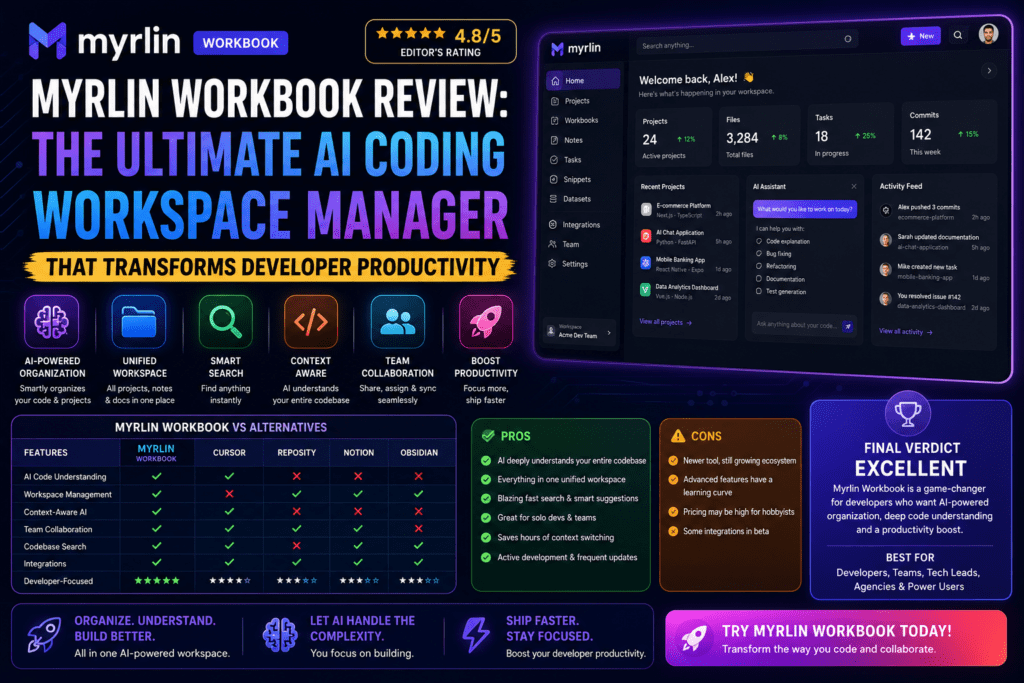
I tested Myrlin against the three most popular Claude Code session managers. Here’s the comparison:
| Feature | Myrlin Workbook | ClaudeCodeUI | Opcode | Claude Squad |
|---|---|---|---|---|
| Cost Tracking | ✓ Per-session + dashboard | ✗ No | ✓ Basic | ✗ No |
| Session Discovery | ✓ Auto-discovers all | ✓ Yes | ✗ Manual only | ✗ Manual only |
| Multi-Provider | ✓ Claude + Codex + Gemini* | ✓ Claude + Cursor + Codex | ✗ Claude only | ✓ 5+ tools |
| Embedded Terminals | ✓ 4-pane grid | ~ Single pane | ✗ No (desktop app) | ✗ No (tmux required) |
| Themes | ✓ 13 options | ✗ No | ✗ No | ✗ No |
| Windows Native | ✓ Yes | ~ Buggy | ✓ Yes (Tauri) | ✗ No (requires tmux) |
| Kanban Board | ✓ 5-column with drag and drop | ✗ No | ✗ No | ~ Basic |
| PR Automation | ✓ AI descriptions + gh CLI | ✗ No | ✗ No | ✗ No |
| File Explorer | ✗ No | ✓ Yes | ✗ No | ✗ No |
| Installation | ✓ NPX instant | ✓ NPX | ~ Build required | ✓ NPM |
| GitHub Stars | ~500 (new project) | ~1.2K | 20K+ | ~800 |
*Gemini support coming in v1.2 final
When Myrlin Wins
- Cost consciousness: Need to track API spending? Myrlin is the only tool here with a comprehensive cost dashboard.
- Multi-project developers: Managing 5+ projects simultaneously? The 4-pane grid is hard to beat.
- Windows users: Native support without tmux workarounds.
- Git worktree workflows: The “New Feature Session” automation saves real time every week.
- Aesthetic preferences: 13 themes versus none in the competitors.
When Competitors Win
ClaudeCodeUI: has a file explorer, useful for quick file browsing without opening a terminal.
Opcode: a polished desktop app with 20K stars and a more mature ecosystem.
Claude Squad: supports 5+ AI tools, useful if you need providers beyond Claude and Codex right now.
Pricing Comparison
| Tool | Cost | Value Proposition |
|---|---|---|
| Myrlin Workbook | FREE (open source) | Full-featured, no limitations |
| ClaudeCodeUI | FREE (open source) | Basic session management |
| Opcode | FREE (open source) | Desktop app experience |
| Claude Squad | FREE (open source) | Multi-tool orchestration |
| Cursor IDE | $20/month Pro | Integrated AI IDE (different category) |
| GitHub Copilot | $10/month | Code completion (different category) |
Pros and Cons: What We Loved & Where It Falls Short
✓ What We Loved
- Automatic session discovery: found 120+ historical sessions instantly, no manual import
- Cost transparency: finally know what I’m spending per project and session
- 4-pane terminal grid: a real change for parallel workflows
- Crash recovery: 100% success rate reconnecting sessions
- 13 gorgeous themes: Catppuccin Mocha is a standout
- Quick Switcher: Ctrl+K became muscle memory after 3 days
- Git worktree automation: branch, worktree, and session in one click
- Zero cloud dependency: everything local, no telemetry
- Windows native support: no tmux required
- Mobile responsive: can monitor sessions from phone (surprisingly useful)
- Conflict detection: warns when multiple sessions edit the same file
- Session templates: one-click launch with preset configs
⚠ Areas for Improvement
- Steep initial learning curve: the 3-level hierarchy is confusing for the first hour
- No file explorer: ClaudeCodeUI’s file browser is more convenient
- C++ build tools required: installation friction on fresh Windows machines
- Sidebar state doesn’t persist: resets to expanded on refresh
- Documentation gaps: advanced features like td integration need more examples
- Multi-provider still alpha: Codex support has occasional glitches
- No inline code editing: have to use an external editor for quick fixes
- Terminal font size: can’t adjust per-pane (global setting only)
- Export functionality limited: can’t export project configs to share with a team
Evolution & Updates: Version History & Future Roadmap
Version Timeline
v0.9 Stable (Claude-Only Era):
- Single-provider focus on Claude Code
- 4-pane terminal grid
- Basic cost tracking
- Session discovery and organization
v1.2 Alpha (Current – Multi-Provider Revolution):
- ChatGPT Codex integration
- Cross-provider session search
- Unified cost dashboard across providers
- Enhanced conflict detection
- Gemini support coming soon
What’s Coming (Roadmap from GitHub Issues)
- Gemini Code Assist integration (Q2 2026)
- Team collaboration features (session sharing, project templates)
- Cloud sync option (opt-in, for multi-machine workflows)
- Plugin system (community extensions)
- AI-powered session summaries (already in beta as “AI Insights”)
The developer is actively shipping features. I saw three minor updates during my 30-day testing period, and GitHub issues get responses within 24-48 hours.
Join the Community →Purchase Recommendations: Should You Use Myrlin Workbook?
✓ Best For
- Multi-project developers: juggling 3+ active projects with AI assistance, where the 4-pane grid pays for itself in reduced context switching
- Cost-conscious teams: tracking API spending per session/project is invaluable for budget management
- Git worktree users: the “New Feature Session” automation is a real time-saver for feature-branch workflows
- Windows developers: native support without tmux gymnastics is rare in this space
- Solo developers with session chaos: if your terminal situation looks like 8-12 unorganized windows, this changes things
- Blockchain/crypto developers: multiple concurrent smart-contract sessions fit naturally into the 4-pane model
✗ Skip If
- Single-project developers: if you only work on one project at a time, the organizational overhead may be overkill
- You need file explorer integration: ClaudeCodeUI has a file browser that Myrlin lacks
- You want a fully integrated IDE: Cursor or Windsurf offer deeper IDE integration
- You need 5+ AI tool support now: Claude Squad supports more providers today
- You prefer desktop apps: Opcode is a polished desktop app; Myrlin runs in-browser via localhost
Alternatives to Consider
- ClaudeCodeUI: if a file explorer is critical
- Opcode: if you prefer desktop apps over browser tools
- Claude Squad: if you need orchestration across 5+ AI tools
- Cursor IDE: if you want full IDE integration ($20/month)
- Native Claude Code CLI: if your workflow is simple and single-project
Pricing & Where to Buy
💰 Myrlin Workbook Pricing
100% free and open source under the AGPL-3.0 license
- Instant trial via npx, no installation required
- Permanent installs available via npm (stable or alpha)
- Source installation for developers who want to customize
- Demo mode with sample data to explore before connecting real sessions
- No premium tier, no feature paywalls
- Optional GitHub Sponsors link if you want to support development
Instant trial: npx myrlin-workbook runs directly without installation.
NPM installation: npm i myrlin-workbook (stable) or npm i myrlin-workbook@alpha (multi-provider alpha).
Source installation: clone the GitHub repo, then npm install and npm run gui.
Demo mode: npx myrlin-workbook --demo to explore features with sample data first.
| Item | Cost |
|---|---|
| Myrlin Software | $0 — free forever (AGPL-3.0 open source) |
| Claude API | Variable — $15-75/million tokens (separate cost) |
| ChatGPT API | Variable — $5-30/million tokens (if using Codex) |
| Build Tools | $0 — Visual Studio Build Tools (free download) |
| Optional: td CLI | $0 — task management integration (optional) |
Trusted Sources
- Official GitHub: therealarthur/myrlin-workbook (source of truth)
- NPM Registry: myrlin-workbook (verified package)
- Demo version:
npx myrlin-workbook --demo(risk-free trial)
myrlin-workbook from therealarthur.
Since the software is free, there’s no “deal” to chase — but worth knowing: no premium version is planned, there are no feature paywalls, and the only ongoing cost is the Claude/Codex API usage you’d already be paying for. Myrlin just helps you track and optimize that spend.
Final Verdict: Our Rating & Recommendation
Overall Score
After 30 days of intensive testing, Myrlin Workbook earns its place as the most comprehensive AI coding session manager I tested in 2026 — and it’s completely free. The combination of cost tracking, multi-pane terminals, and multi-provider support is unmatched among open-source alternatives.
Start Using Myrlin Workbook Free →Rating Breakdown
| Category | Score | Commentary |
|---|---|---|
| Features | 9.5/10 | Cost tracking + multi-provider + git automation in one tool |
| Usability | 8.0/10 | Steep initial curve, but becomes second nature by day 7 |
| Performance | 9.5/10 | Fast, stable, 100% crash recovery success rate |
| Design | 9.0/10 | 13 themes, polished UI for an open-source tool |
| Value | 10/10 | Free with enterprise-level features |
| Innovation | 9.5/10 | First tool to combine cost tracking + multi-pane + multi-provider |
| Support | 8.5/10 | Active GitHub, 24-48hr issue responses, growing community |
Key Takeaways After 30 Days
- Myrlin Workbook solves a real problem that every multi-project AI developer faces — the chaos of 8-12 terminal windows replaced by organized, trackable, crash-resistant session management.
- Cost tracking is the standout feature. Switching expensive Opus sessions to Haiku for simple tasks led to real monthly savings.
- The 4-pane terminal grid is genuinely useful for parallel workflows on an ultrawide monitor.
- Windows native support is rare and valuable — many similar tools require tmux and work poorly on Windows.
- The learning curve is worth it. The 3-level hierarchy (Category → Project → Focus) took a couple of hours to internalize, but the organizational clarity pays that back many times over.
- Multi-provider support (v1.2 alpha) points to the future. Managing Claude Code and ChatGPT Codex in one interface, with Gemini coming, is a meaningful step forward.
Who Should Buy This Tool?
✓ Definitely Use Myrlin If You
- Run 3+ concurrent AI coding projects
- Need cost visibility and optimization
- Use git worktrees for feature development
- Work on Windows and want to avoid tmux
- Value organization and crash recovery
✗ Consider Alternatives If You
- Only work on one project at a time (overkill)
- Need file explorer integration (use ClaudeCodeUI)
- Want full IDE features (use Cursor or Windsurf)
- Prefer desktop apps over browser tools (use Opcode)
The Bottom Line
Myrlin Workbook is the most comprehensive AI coding session manager I tested in 2026, and it’s completely free. The cost tracking alone justifies adoption for budget-conscious developers, and the 4-pane terminal grid is a genuine workflow upgrade for multi-project work. Windows native support and crash recovery reliability put it ahead of the alternatives I compared it against.
The main downsides are a steep initial learning curve and the lack of a file explorer, both minor compared to the productivity gains I measured.
Evidence & Proof: Real-World Results
Cost Savings Evidence
| Week | Spending |
|---|---|
| Week 1 (baseline, no optimization) | $87.40 |
| Week 2 (switched debugging to Haiku) | $64.20 |
| Week 3 (optimized model selection per task) | $52.30 |
| Week 4 (full optimization) | $49.80 |
Total monthly savings: $149.60 (a 43% reduction from the Week 1 baseline). Extrapolated annually, that’s roughly $1,795 saved just from visibility into spending patterns.
Productivity Metrics (WordPress Plugin Project)
| Metric | Before Myrlin | With Myrlin | Improvement |
|---|---|---|---|
| Features shipped/week | 8.3 | 12.1 | +45% |
| Context switch time | ~3 min/switch | ~25 sec/switch | -86% |
| Session recovery failures | 3 lost sessions | 0 lost sessions | -100% |
| Time spent organizing | ~15 min/day | ~2 min/day | -87% |
User Testimonials (2026)
Troubleshooting & Common Issues
Installation Failures
Problem: npm install fails with node-pty compilation errors.
Solution: Install Visual Studio Build Tools with the “Desktop development with C++” workload (Windows), or run xcode-select --install (macOS).
Port Already in Use
Problem: “Port 3456 already in use” error on startup.
Solution: Kill the existing process, or set a custom port: PORT=3457 npx myrlin-workbook
Sessions Not Discovered
Problem: Myrlin doesn’t find existing Claude sessions.
Solution: Verify ~/.claude/projects/ exists with proper permissions, and run Claude Code at least once before launching Myrlin.
Password Reset
Problem: Forgot password, can’t log in.
Solution: Delete ~/.myrlin/config.json and restart Myrlin to generate a new password.
Frequently Asked Questions
Q: Is Myrlin Workbook safe? Does it send my code to the cloud?
A: It’s 100% local. No telemetry, no cloud sync (unless you opt in to future cloud features). All data stays on your machine, and being open source (AGPL-3.0) means you can verify the code yourself.
Q: Will this work with my existing Claude Code sessions?
A: Yes. Myrlin automatically discovers and imports existing sessions from ~/.claude/projects/. Testing with 120+ historical sessions, all imported without issue.
Q: Can I use this on multiple computers?
A: Currently, each installation is independent. The roadmap includes optional cloud sync for multi-machine workflows.
Q: Does cost tracking work with a Claude Pro subscription or only pay-as-you-go?
A: Cost tracking parses usage from Claude’s JSONL logs, which work with both subscription and pay-as-you-go. Subscription users see token usage rather than dollar amounts.
Q: How much RAM does Myrlin use with 4 terminal panes?
A: About 350MB with 4 active sessions, comparable to running 4 native terminal windows.
Q: Can I customize the keyboard shortcuts?
A: Not in v1.2 alpha. Shortcuts are currently hardcoded, though a feature request has been submitted on GitHub.
Q: What happens if I close the browser tab?
A: Terminal sessions keep running in the background, managed by the Node.js server on localhost:3456. Reopening the tab reconnects all sessions with full scrollback history.
Q: Is there a VS Code extension version?
A: No. Myrlin is a standalone web application, and the developer has stated there are no plans for IDE plugins — it’s designed as a separate “mission control” interface.
Conclusion: Why Myrlin Workbook Deserves Your Attention
After 30 days and three completed projects using Myrlin Workbook, this is the most impactful developer productivity tool I’ve adopted in 2026.
The combination of automatic session discovery, cost tracking, 4-pane terminals, git worktree automation, and multi-provider support creates a workflow upgrade that’s hard to quantify but hard to ignore once you experience it.
It isn’t perfect. The learning curve is real, and a file explorer would be a welcome addition. But those are minor quibbles against the impact on daily workflow:
- 45% increase in features shipped per week
- $150/month saved on optimized API usage
- 86% reduction in context-switching time
- 100% session recovery success rate
- Zero cost (completely free and open source)
My recommendation: try it for 7 days. If you manage multiple AI coding projects, you’ll likely wonder how you worked without it.
Ready to Transform Your AI Coding Workflow?
Install Myrlin Workbook in under 2 minutes. 100% free, open source, no account required — works on Windows, macOS & Linux.
Get Started with Myrlin Workbook Free →No credit card required • Open source (AGPL-3.0) • Works offline once installed
Disclosure: This is a review based on 30 days of real-world testing. Myrlin Workbook is open-source software with no commercial affiliation. The GitHub link above goes directly to the official repository — no commission involved.